<?xml version="1.0" encoding="utf-8"?><feed xmlns="http://www.w3.org/2005/Atom" ><generator uri="https://jekyllrb.com/" version="4.3.3">Jekyll</generator><link href="https://www.romanklinger.de/feed.xml" rel="self" type="application/atom+xml" /><link href="https://www.romanklinger.de/" rel="alternate" type="text/html" /><updated>2026-03-04T16:49:34+01:00</updated><id>https://www.romanklinger.de/feed.xml</id><title type="html">Roman Klinger’s Homepage</title><subtitle>Homepage by Roman Klinger and a blog about natural language processing and computational linguistics research.</subtitle><author><name>Roman Klinger</name></author><entry><title type="html">Conference Report: ACL 2025</title><link href="https://www.romanklinger.de/blog/2025-08-01-acl/" rel="alternate" type="text/html" title="Conference Report: ACL 2025" /><published>2025-08-01T12:00:00+02:00</published><updated>2025-08-01T12:00:00+02:00</updated><id>https://www.romanklinger.de/blog/acl-report</id><content type="html" xml:base="https://www.romanklinger.de/blog/2025-08-01-acl/"><![CDATA[<h2 id="conference-of-the-association-for-computational-linguistics-acl">Conference of the Association for Computational Linguistics (ACL)</h2>

<p>End of July 2025, I participated in the <a href="http://2025.aclweb.org/">ACL</a>
in Vienna. ACL is the biggest natural language processing conference,
and (currently) one of only two conferenes which are considered A*
(according to the <a href="https://portal.core.edu.au/conf-ranks/?search=acl&amp;by=all&amp;source=CORE2023&amp;sort=atitle&amp;page=1">CORE
Ranking</a>.
The other A* conference is <a href="https://2025.emnlp.org/">EMNLP</a> – the
conferences of the chapters are considerd A (EACL, NAACL) or B (IJCNLP).
While I do not think that the differences between A and A* are too
important; and sometimes also B conferences are preferably when they are
topically more relevant for a paper, this aspect makes this conference
to be a very popular.</p>

<h2 id="statistics">Statistics</h2>

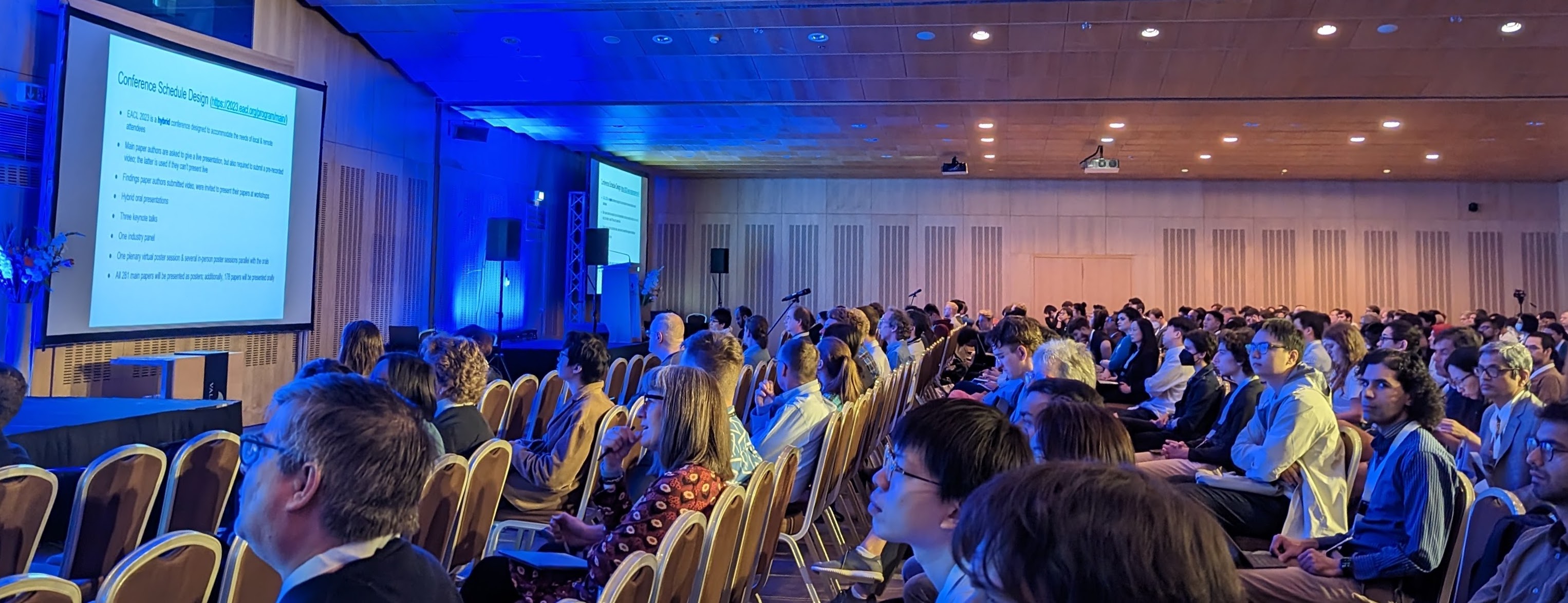
<p>This has been the biggest conference ever, as far as I know. Regarding
the number of participants, I heard various numbers, ranging from 5400
participants on site (plus 1500 online participants) to 6400
participants in Vienna. During the opening session, the following
numbers were mentioned:</p>

<ul>
  <li>1700 main conference</li>
  <li>1400 Findings papers</li>
  <li>108 industry papers</li>
  <li>800 workshop papers</li>
  <li>104 student research papers</li>
  <li>64 demo papers</li>
</ul>

<p>The review process went, again through
<a href="https://aclrollingreview.org/">ARR</a>, where papers are first reviewed
independent of a concrete conference, and after a potential revise and
resubmit, when the scores look like the paper could be accepted, it is
“committed” to a conference. 4700 papers have been committed from the
directly preceding review cycle, out of which 1600 were revisions.
However, also 800 papers have been directly submitted from the review
cycle preceding this one, presumably because the authors did prefer to
submit to a conference in Europe.</p>

<p>One topic that triggered quite some “oh” and “ah” in the opening
presentation was the aspect that chinese authors contributed 50% of the
papers and the US only 19% a substantial increase and decrease. In
social media, some people attributed this presumed decrease in
productivity to the new administration in the US. I find this
questionable reasoning, there are many aspects affecting where papers
are sent, and in 2025 also a NAACL took place in Albuquerque. At the
same time, people in China might prefer to commit to a conference in
Europe. South Korea continued to increase the number of contributions,
followed by UK and Germany (all 3%).</p>

<p>Quite a diverse set of topics was present at the conference, but the pie
chart is not representing well how many papers did focus on work with
large language models. I think most papers did at least use LLMs for
their modeling experiments in some way.</p>

<p><img src="/blog-assets/2025-08-01/topics.jpg" alt="Distribution of topics" /></p>

<h2 id="organization">Organization</h2>

<p>The organizers at this conference made a couple of decisions to do
things differently than in previous editions. I’d like to share my
opinion about them.</p>

<ul>
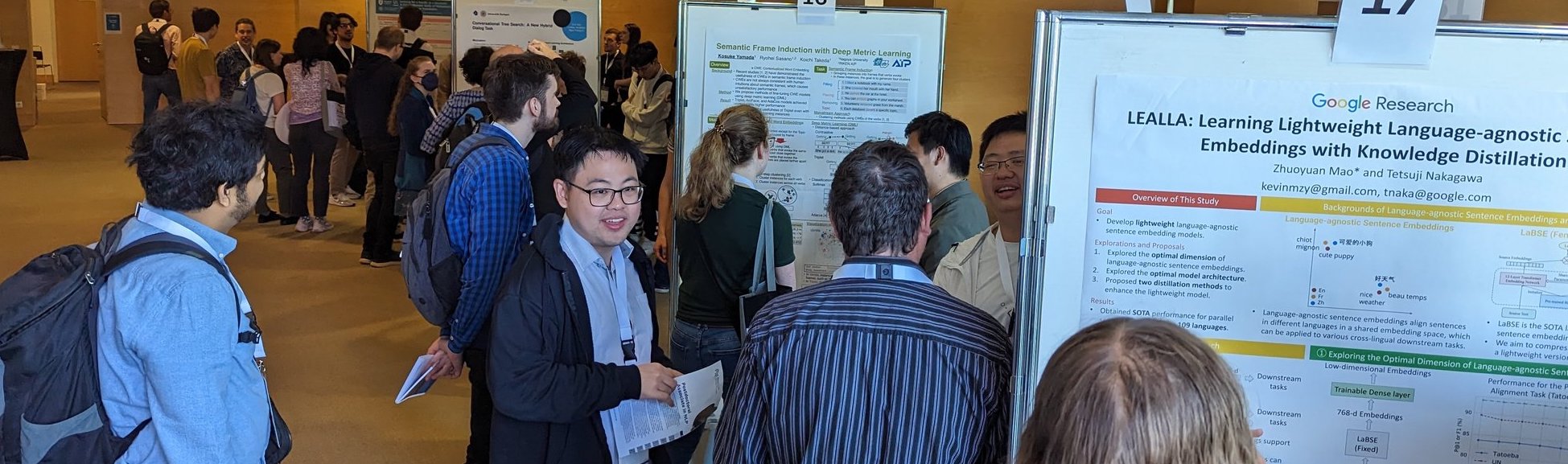
  <li><em>There was no poster session in parallel to oral presentations.</em>
This lead to the poster sessions being very crowded, while the
lecture halls were (presumably) empty. Maybe this needed to be like
that for some reason, but I would have preferred to be able to chose
between posters and talks in parallel sessions, and the poster
sessions being smaller.</li>
  <li><em>There was no apparent clustering of the poster.</em> I did not perceive
a topical clustering of the posters, and for me, it was sometimes
necessary to walk quite far distances from one interesting poster to
another. Also, I like to randomly roam around posters that I might
like. This did not work at all. One needed, before the poster
session, make a list of posters to see and directly go there.</li>
  <li><em>The talks were partially in tiny rooms.</em> First I thought “this is
nice”. The session on argument mining was in a room for about 40-60
people. That felt like an environment where people could actually
discuss. Once the room was full, people needed to wait outside and
couldn’t join, this impression was not that positive any more. This
was particularly bad in one workshop for which I registered and in
which I presented a poster. The poster presentation was 5 minutes
away from the room for the workshop, and when I tried to come back,
I couldn’t participate in the workshop. This was very frustrating.
My impression is that the venue just did not have enough rooms of a
sufficient size; so that is something that couldn’t easily be
solved. But at least in the workshops, people who did register
should have given preference.</li>
  <li><em>Panel discussions after presentations</em>. This was an interesting
experiments. After speakers gave presentations and answered
questions, there was a short panel discussion amongst the speakers
of one session, moderated by the session chair. In principle I think
this is a great idea, but the papers were not close enough
topic-wise in the sessions I participated in with this format such
that this worked out. I’d like to see a second iteration of this
idea though.</li>
</ul>

<p>Altogether, this was, for me, the most difficult conference to navigate,
so far. I am not sure if this was because of the shere size or because
of other reasons. Clustering posters by topic similarity would
definitely be a big wish from me for the next conferences.</p>

<p><img src="/blog-assets/2025-08-01/poster.jpg" alt="Poster Session" /></p>

<h2 id="own-contributions-to-the-conference">Own Contributions to the Conference</h2>

<p>We had a set of contributions to this conference, which I would like to
briefly summarize in the following.</p>

<ul>
  <li><a href="https://aclanthology.org/2025.acl-long.848/">Schäfer et al. (2025)</a>
reports on our experiments with socio-demographic prompting for
offensive language detection with instruction-tuned models. We
tested if socio-demographic prompting (make prediction from the
perspective of a person with a particular age or gender) has an
effect stronger than pseudo-demographic prompts (the house number of
a person). Further, we tested to which demographics a prediction is
most similar if no demographics are provided in the prompt. We
found, as expected, that some particular demographics seem to be
better represented in large language models. This paper was the
result of a joint effort from the whole group – writing one paper in
one week during our first retreat. We are very happy that this paper
made it into the main conference; but we also agree that the stress
level of writing a paper in this short amount of time was too high.
By the way, thanks to <a href="https://www.utn.de/person/prof-dr-steffen-eger/">Steffen
Eger</a> for the idea
to do such type of retreat. It worked really well to get to know
each other and that was clearly a success in the retreat.</li>
  <li><a href="https://aclanthology.org/2025.acl-long.847/">Bagdon et al. (2025)</a>
studied various ways to get emotion and appraisal annotated data. In
our project ITEM (with <a href="https://sites.google.com/view/carinasilberer/home">Carina
Silberer</a> from
Stuttgart), we investigate how and why social media users express
their emotions, particularly implicitly with text and images. In the
paper we published at the main conference of ACL 2025, we wanted to
understand if asking crowdworkers to create a post for a given
emotion and including an image that would realistically use from an
image data base works as a reasonable approximation for realistic
data. The advantage would be that the data has less data privacy
issues and copyright issues than real data. We compared these data
to “donation” (we paid for them though) of real posts from users. We
find that the experimentally elicited data is fine as training data,
but to study the phenomena one needs real test data.</li>
  <li><a href="https://aclanthology.org/2025.bionlp-1.18/">Greschner, Wührl, and Klinger
(2025)</a> presented her
work on the question if we can automatically detect aspects that
influence the perceived quality of life of people with mental
disorders from social media, which are not yet known. To do so, she
annotated data, built classifiers, and did topic modeling and found
a set of aspects that were not yet represented in standardized test
instruments.</li>
  <li><a href="https://aclanthology.org/2025.xllm-1.4/">Papay, Klinger, and Padó
(2025)</a> proposed a method
to consider long-distance relations in text on the output level –
with a conditional random field (joint work with <a href="https://nlpado.de/~sebastian/">Sebastian
Pado</a> from Stuttgart). This CRF could
be put on top of a neural network and is therefore a relevant option
for an output layer. Most importantly, Sean found a way to decode in
linear runtime, which is not generally possible for loopy
probabilistic structures.</li>
  <li><a href="https://aclanthology.org/2025.acl-srw.18/">Jiahui Li and Klinger
(2025)</a> published the
first paper from our INPROMPT project, in which we develop prompt
optimization and engineering methods that involve a human user
whenever automatic optimization is not sufficiently successful.
Therefore, the proposed methods support human prompt developers. The
paper in the student research workshop summarizes the project plans
and discusses the upcoming research questions and tasks.</li>
  <li><a href="https://aclanthology.org/2025.realm-1.1/">Hofmann, Sindermann, and Klinger
(2025)</a> has been presented
by me, but the work has been conducted mainly by Jan Hofmann (in
collaboration with <a href="https://www.iris.uni-stuttgart.de/people/Sindermann/">Cornelia
Sindermann</a>
from Stuttgart and Ulm). In this work, we studied language model
based agents which learn which posts in a social media profile are
helpful for personality profiling. The data is only annotated on the
profile level, so we use a reward function for reinforcement
learning to learn to distinguish relevant and irrelevant posts. The
method could readibly be transferred to any other long-text analysis
and shows substantial runtime and cost savings, because the prompt
that makes the personality prediction can work without a lot of
provided context.</li>
</ul>

<p><img src="/blog-assets/2025-08-01/group.jpg" alt="Photo of the BamNLP Group in front of the conference venue" /></p>

<h2 id="my-favorite-contributions">My Favorite Contributions</h2>

<p>In the following, I want to highlight some papers that have been
presented (or at least published) at this ACL. As I said - I found this
conference particularly difficult to navigate; and if I don’t mention a
paper that you would expect me to like it doesn’t mean that I didn’t
like it. I probably just missed it (and I’d appreciate if you told me
about that paper that I should read.).</p>

<h3 id="emotion-analysis">Emotion analysis</h3>

<ul>
  <li><a href="https://aclanthology.org/2025.acl-long.306/">Palma et al. (2025)</a>
aim at understanding where emotion and sentiment information is
represented in large language models. They then train small models
on the local emotion/sentiment representation which works better
than fine-tuning the whole model (and it is cheaper).</li>
  <li><a href="https://aclanthology.org/2025.law-1.7/">Du and Hoste (2025)</a>
propose to calculate annotator disagreement not based on categorical
values but instead map them to a valence and arousal space in which
the continuous values are used for an error estimation. They show
that such disagreement calculation is a more realistic estimate.</li>
  <li><a href="https://aclanthology.org/2025.law-1.1/">Barz et al. (2025)</a> do also
focus on inter-annotator agreement, but more on understanding (the
reasons for) disagreement. The authors annotate a corpus on
environmental aspects and analyze it for topics and emotion
distributions. Understanding disagreement was mostly analyzed based
on qualitative interviews and less on statistical analyses. One main
reason for disagreement were different perspectives, another reason
to build personalized models and include contextuali information in
corpora (like we did for instance in <a href="https://aclanthology.org/2023.cl-1.1/">Troiano, Oberländer, and
Klinger (2023)</a>, but the idea
of qualititative interviews in this ACL2025 paper are a good idea
that I really like).</li>
  <li><a href="https://aclanthology.org/2025.findings-acl.806/">Lee, Lee, et al.
(2025)</a> detect
neurons that are particularly relevant for particular emotions and
show that removing them comes with a drop in emotion classification
performance.</li>
  <li><a href="https://aclanthology.org/2025.acl-long.1042">Jiayi Li et al.
(2025)</a> reproduce prior
work that shows that readers have limited ability to reproduce
writer’s emotions; and LLMs are better than humans. The particular
novelty is that the authors distinguish ingroup and outgroup
annotations. The related work section is unfortunately a bit limited
in this paper - there has been work that failed to show such
influence of demographic factors in natural language processing
(while its known across other modalities). I still would like to
understand which factors influence if in/outgroup context matters or
not.</li>
  <li><a href="https://aclanthology.org/2025.acl-long.1130/">Lee, Jang, et al.
(2025)</a> is an
interesting study, because the authors use entirely automatically
generated data, and then study how language models analyze this
artificial data. Currently, I do not have a good understanding what
the findings in the paper mean - because neither the data nor the
annotations are human-made or naturally occurring. I admit that the
data is generated based on human data though, but it is not clear to
me if the findings therefore generalize to data as it occurs in the
wild naturally. A similar criticism also applies to a lot of studies
we do, in which we elicit data from humans in non-natural
experimental environments. I think the question how much such
analysis allow interesting insights is still an open research
question.</li>
  <li><a href="https://aclanthology.org/2025.acl-long.436/">Muhammad et al.
(2025)</a> is not just
another emotion data set. It is a corpus for many languages, and
many of which did not receive enough attention yet. The corpus is
manually annotated, contains many domains and various genres. It
contains intensity and categorical labels.</li>
  <li><a href="https://aclanthology.org/2025.acl-short.88/">Duong et al. (2025)</a>
is the first work that I am aware of that annotates emotion
expressions for bodily reactions. We did also find in <a href="https://aclanthology.org/2021.konvens-1.5/">Casel,
Heindl, and Klinger
(2021)</a> that a
substantial number of emotion expressions use body descriptions, so
it is really nice to see this work. The authors also rely on
automatic annotation with best-worst scaling, as proposed by <a href="https://aclanthology.org/2024.naacl-long.439/">Bagdon
et al. (2024)</a>.</li>
</ul>

<h3 id="appraisals-in-emotion-analysis">Appraisals in Emotion Analysis</h3>

<ul>
  <li><a href="https://aclanthology.org/2025.findings-acl.679">Tak et al. (2025)</a>
builds on top of our Crowd-enVent corpus to study the cognitive
evaluation process taking place in emotion event processing. While
our corpus only provided emotion and appraisal annotation and
predictions (<a href="https://aclanthology.org/2023.cl-1.1/">Troiano, Oberländer, and Klinger
(2023)</a>) the authors of this
paper really focus on understanding how LLMs process emotions and if
that process is aligned with human processing. To do so, they build
on top of the idea of mechanistic interpretability, by probing the
model. A very impressive idea in this paper is to make use of the
model understanding to then intervene on the cognitive evaluation
process to study the relation to the emotion category. I like
appraisals and the authors use our data, so I am biased, but this
paper goes the extra mile to bring together LLM introspection
methods with psychological concepts.</li>
  <li><a href="https://aclanthology.org/2025.findings-acl.1359/">Yeo and Jaidka
(2025)</a> build on
top of appraisals, which they consider to be a fundament for the
interpretation of implicitly expressed emotions, to curate a data
set focused on the Theory of Mind. They focus therefore not so much
on the analysis of emotions from one particular perspective, but on
the interpretation of an emotion in a person as a private state. I
think this is also quite related to various work on empathy. While I
really like the idea, this paper suffers a bit from the lack of a
related work section (due to it being a short paper, but still, the
context of this work is a bit opaque for me).</li>
  <li><a href="https://aclanthology.org/2025.conll-1.16/">Debnath, Graham, and Conlan
(2025)</a> train an
appraisal predictor on our appraisal data set Crowd-enVent and
automatically label dialogue data to study the information flow in
dialogues. The paper therefore brings together event-centered
emotion analysis (<a href="https://aclanthology.org/2023.bigpicture-1.1/">Klinger
(2023)</a>) and emotion
recognition in conversations (<a href="https://doi.org/10.1007/s10462-024-11010-y">Pereira, Moniz, and Carvalho
(2024)</a>). They do so in
a multi-task learning setup, which may also benefit from the emotion
labels in the conversation data.</li>
</ul>

<h3 id="personality">Personality</h3>

<ul>
  <li><a href="https://aclanthology.org/2025.findings-acl.435">Wei et al. (2025)</a>
ensure that a dialogue, guided by an LLM is consistent regarding the
emotion and the personality. They do so by modeling the emotion and
personality transitions with a Markov chain. What is not clear for
me in this paper is if personality and emotions are handled
differently according to the fact that one is a state and the other
are traits.</li>
  <li><a href="https://aclanthology.org/2025.acl-long.1515">Lim et al. (2025)</a>
show how agents in text-based games change their behaviour based on
different personality traits.</li>
  <li><a href="https://aclanthology.org/2025.findings-acl.1085/">Hartley et al.
(2025)</a> study how
LLMs change their risk-taking behaviour based on differing
personality traits given as conditions. This work is related to our
work on measuring regulatory focus theory (RFT, promotion or
prevention orientation), but we did only build classifiers
(<a href="https://aclanthology.org/2023.nejlt-1.8/">Velutharambath, Sassenberg, and Klinger
(2023)</a>). The authors here
do use personality conditions for guiding the behaviour of an agent.
Bringing RFT and such studies together could be an interesting step
in future work.</li>
</ul>

<h3 id="other">Other</h3>

<ul>
  <li><a href="https://aclanthology.org/2025.findings-acl.133/">Wu et al. (2025)</a>
may be the first paper on music information retrieval I have seen at
ACL conferences. They authors align sheet music, audio recordings,
performance data and multilingual text for an improved retrieval
process.</li>
  <li><a href="https://aclanthology.org/2025.argmining-1.12/">Quensel, Falk, and Lapesa
(2025)</a> study
subjective factors of argument strengths. Their work aggregates
various aspects such as emotions, hedging and storytelling in a
joint analysis. The emotion labels stem from a domain transfer of a
predefined corpus. Next to our work ((Greschner and Klinger
(2025))[https://aclanthology.org/2025.nlp4dh-1.52/]) this is one
of the few studies that do not consider binary emotionality but
distinguish various emotion categories.</li>
  <li><a href="https://aclanthology.org/2025.acl-long.1060/">Menis Mastromichalakis et al.
(2025)</a> advcocate for
not removing harmful information from historic sources; but instead
automatically contextualize the information, such that it is better
understood. I find this is an interesting perspective on offensive
language processing.</li>
  <li><a href="https://aclanthology.org/2025.acl-long.1224/">Pramanick et al.
(2025)</a> is a
meta-study on the research field of NLP. The authors show
empirically that the focus on language shifts towards more
computational methods, people care more about human-centric studies,
and that there is a steady increase in methods and data sets.</li>
  <li><a href="https://aclanthology.org/2025.acl-long.267/">Russell, Karpinska, and Iyyer
(2025)</a> probably has
the best title in this conference, because it makes it very easy to
summarize the main result: “People who frequently use ChatGPT for
writing tasks are accurate and robust detectors of AI-generated
text”</li>
  <li><a href="https://aclanthology.org/2025.acl-long.395/">Sicilia and Alikhani
(2025)</a> also study
theory of mind (as mentioned further above), but with a focus on
uncertainty prediction. The authors propose a benchmark to evaluate
the uncertainty in participants in a dialogue. Therefore, the
prediction is really not about the language model, but of a second
order. Very interesting idea and a new twist to uncertainty
prediction!</li>
  <li><a href="https://aclanthology.org/2025.acl-long.408/">Corso, Pierri, and De Francisci Morales
(2025)</a> propose data
and methods to find conspiracy theories on TikTok. An interesting
task and setup. What remains is a study what the properties of these
conspiracy theories are, and if also novel instances can be found.
Otherwise, the task might not focus on properties of the instances,
but only on similarities.</li>
  <li><a href="https://aclanthology.org/2025.acl-long.439/">F. Chen et al. (2025)</a>
ask people to judge the own perceived empathy in a story, without
clearly defining the task for the annotators. This is an interesting
idea, because it leaves the decision what “empathy” actual means to
the annotators. Maybe it is related to stance or opinion in this
setup.</li>
  <li><a href="https://aclanthology.org/2025.acl-long.593/">Jin et al. (2025)</a> is
the first work I have seen that does study argument quality with a
clear perspectivism angle - people with different backgrounds assess
arguments differently. Unfortunately, the persona descriptions are
automatically generated, and the assessment and rational generation
also seems to only be automatic. It is not clear to me if there is
human annotation from these various personas is involved.</li>
  <li><a href="https://aclanthology.org/2025.acl-long.799/">Yang and Jin (2025)</a>
perform book-long evaluations automatically, but with the help of
human assigned scores. The setup is quite interesting: the authors
automatically structure book reviews into a structured
representation; and then, they develop methods to automatically
assess these scores from the book alone. This is challenging because
of the text length, and the authors propose various approaches for
aggregation into a shorter representation.</li>
  <li><a href="https://aclanthology.org/2025.acl-long.916/">Cahyawijaya et al.
(2025)</a> is a paper that
is not exactly related to my main interests - it’s about a data set
to develop vision-language models. The interesting aspect for me
here is that the authors evaluate different ways to collect the
data: they crowdsource, crawl or generate. Therefore, this paper is
quite related to the corpus we publish at the same conference. Our
paper is called “Donate or Create”. While both terms in our case
refer to crowdsourcing, there is an interesting overlap in
methodology (<a href="https://aclanthology.org/2025.acl-long.847/">Bagdon et al.
(2025)</a>). The authors
of this paper, however, do also evaluate automatic data generation,
which is something we did not do (yet). By the way, it’s also the
first paper which has enough authors such that the abstract
continues on the second page ;-).</li>
  <li><a href="https://aclanthology.org/2025.acl-short.20/">Bavaresco et al.
(2025)</a> is a very nice
exception from the many papers that ask “can LLMs do X” by studying
the same question in a systematic manner, across many tasks. I think
this is a very natural but very well carried out study that
consolidates various ideas that came up in recent work. I assume
this will be one of the mostly highly cited papers in this
conference.</li>
  <li><a href="https://aclanthology.org/2025.findings-acl.1250/">Y. Chen and Eger
(2025)</a> describes
results that come from the same project as <a href="https://aclanthology.org/2025.nlp4dh-1.52">Greschner and Klinger
(2025)</a>. The authors of
this paper do automatically generate non-emotional arguments and
emotional arguments with language models, to setup a human
annotation study in a controlled manner.</li>
</ul>

<p>The whole <a href="https://aclanthology.org/events/acl-2025/">proceedings</a> are
available in the ACL Anthology.</p>

<h2 id="venue-and-place">Venue and Place</h2>

<p>The conference took place in Vienna - a city I recently visited for
KONVENS, so my pressure to do sightseeing was not too strong. The
conference was north of the Danube, in an area I have not seen so far,
and it was mostly a modern concrete building with more high concrete
buildings around. What was really nice is that I could cycle every day
from the hotel over a bridge to the venue. Further, there was a
beach/river promenade-like area with some restaurants around; where one
could also go swimming. This was quite nice.</p>

<p>The social event took place in the conference venue, probably the only
possible decision with a conference of this size. I still think that
such conference dinners should not serve meat, given how many animals
they alone are responsible then to kill, but with this opinion I seem to
be quite alone. The vegetarian food quality was good, though.</p>

<p>Next to the unavoidable (and probably expected-by-many) Waltz session,
the DJ had a sax player and two singers; and they were playing Electro
Swing. I did unfortunately not learn who that was, but if any of you
knows, please tell me. I like this type of music quite a lot and was
very happy about this; such parties do not take place in areas in which
I live. Dancing was, however, not possible for me - the floor was moving
so strongly that I couldn’t stay in this area without fear ;-). (nothing
happened though)</p>

<p><img src="/blog-assets/2025-08-01/social.jpg" alt="Social Event" /></p>

<h1 id="bibliography">Bibliography</h1>

<p>Bagdon, Christopher, Aidan Combs, Carina Silberer, and Roman Klinger. 2025. “Donate or Create? Comparing Data Collection Strategies for
Emotion-Labeled Multimodal Social Media Posts.” In <em>Proceedings of the
63rd Annual Meeting of the Association for Computational Linguistics
(Volume 1: Long Papers)</em>, edited by Wanxiang Che, Joyce Nabende,
Ekaterina Shutova, and Mohammad Taher Pilehvar, 17307–30. Vienna,
Austria: Association for Computational Linguistics.
<a href="https://aclanthology.org/2025.acl-long.847/">https://aclanthology.org/2025.acl-long.847/</a>.</p>

<p>Bagdon, Christopher, Prathamesh Karmalkar, Harsha Gurulingappa, and
Roman Klinger. 2024. “‘You Are an Expert Annotator’: Automatic
Best–Worst-Scaling Annotations for Emotion Intensity Modeling.” In
<em>Proceedings of the 2024 Conference of the North American Chapter of the
Association for Computational Linguistics: Human Language Technologies
(Volume 1: Long Papers)</em>, edited by Kevin Duh, Helena Gomez, and Steven
Bethard, 7924–36. Mexico City, Mexico: Association for Computational
Linguistics. <a href="https://doi.org/10.18653/v1/2024.naacl-long.439">https://doi.org/10.18653/v1/2024.naacl-long.439</a>.</p>

<p>Barz, Christina, Melanie Siegel, Daniel Hanss, and Michael Wiegand. 2025. “Understanding Disagreement: An Annotation Study of Sentiment and
Emotional Language in Environmental Communication.” In <em>Proceedings of
the 19th Linguistic Annotation Workshop (LAW-XIX-2025)</em>, edited by Siyao
Peng and Ines Rehbein, 1–20. Vienna, Austria: Association for
Computational Linguistics. <a href="https://aclanthology.org/2025.law-1.1/">https://aclanthology.org/2025.law-1.1/</a>.</p>

<p>Bavaresco, Anna, Raffaella Bernardi, Leonardo Bertolazzi, Desmond
Elliott, Raquel Fernández, Albert Gatt, Esam Ghaleb, et al. 2025. “LLMs
Instead of Human Judges? A Large Scale Empirical Study Across 20 NLP
Evaluation Tasks.” In <em>Proceedings of the 63rd Annual Meeting of the
Association for Computational Linguistics (Volume 2: Short Papers)</em>,
edited by Wanxiang Che, Joyce Nabende, Ekaterina Shutova, and Mohammad
Taher Pilehvar, 238–55. Vienna, Austria: Association for Computational
Linguistics. <a href="https://aclanthology.org/2025.acl-short.20/">https://aclanthology.org/2025.acl-short.20/</a>.</p>

<p>Cahyawijaya, Samuel, Holy Lovenia, Joel Ruben Antony Moniz, Tack Hwa
Wong, Mohammad Rifqi Farhansyah, Thant Thiri Maung, Frederikus Hudi, et
al. 2025. “Crowdsource, Crawl, or Generate? Creating SEA-VL, a
Multicultural Vision-Language Dataset for Southeast Asia.” In
<em>Proceedings of the 63rd Annual Meeting of the Association for
Computational Linguistics (Volume 1: Long Papers)</em>, edited by Wanxiang
Che, Joyce Nabende, Ekaterina Shutova, and Mohammad Taher Pilehvar,
18685–717. Vienna, Austria: Association for Computational Linguistics.
<a href="https://aclanthology.org/2025.acl-long.916/">https://aclanthology.org/2025.acl-long.916/</a>.</p>

<p>Casel, Felix, Amelie Heindl, and Roman Klinger. 2021. “Emotion
Recognition Under Consideration of the Emotion Component Process Model.”
In <em>Proceedings of the 17th Conference on Natural Language Processing
(KONVENS 2021)</em>, edited by Kilian Evang, Laura Kallmeyer, Rainer
Osswald, Jakub Waszczuk, and Torsten Zesch, 49–61. Düsseldorf, Germany:
KONVENS 2021 Organizers. <a href="https://aclanthology.org/2021.konvens-1.5/">https://aclanthology.org/2021.konvens-1.5/</a>.</p>

<p>Chen, Francine, Scott Carter, Tatiana Lau, Nayeli Suseth Bravo, Sumanta
Bhattacharyya, Kate Sieck, and Charlene C. Wu. 2025. “Empathy Prediction
from Diverse Perspectives.” In <em>Proceedings of the 63rd Annual Meeting
of the Association for Computational Linguistics (Volume 1: Long
Papers)</em>, edited by Wanxiang Che, Joyce Nabende, Ekaterina Shutova, and
Mohammad Taher Pilehvar, 8959–74. Vienna, Austria: Association for
Computational Linguistics.
<a href="https://aclanthology.org/2025.acl-long.439/">https://aclanthology.org/2025.acl-long.439/</a>.</p>

<p>Chen, Yanran, and Steffen Eger. 2025. “Do Emotions Really Affect
Argument Convincingness? A Dynamic Approach with LLM-Based Manipulation
Checks.” In <em>Findings of the Association for Computational Linguistics:
ACL 2025</em>, edited by Wanxiang Che, Joyce Nabende, Ekaterina Shutova, and
Mohammad Taher Pilehvar, 24357–81. Vienna, Austria: Association for
Computational Linguistics.
<a href="https://aclanthology.org/2025.findings-acl.1250/">https://aclanthology.org/2025.findings-acl.1250/</a>.</p>

<p>Corso, Francesco, Francesco Pierri, and Gianmarco De Francisci
Morales. 2025. “Conspiracy Theories and Where to Find Them on TikTok.” In
<em>Proceedings of the 63rd Annual Meeting of the Association for
Computational Linguistics (Volume 1: Long Papers)</em>, edited by Wanxiang
Che, Joyce Nabende, Ekaterina Shutova, and Mohammad Taher Pilehvar,
8346–62. Vienna, Austria: Association for Computational Linguistics.
<a href="https://aclanthology.org/2025.acl-long.408/">https://aclanthology.org/2025.acl-long.408/</a>.</p>

<p>Debnath, Alok, Yvette Graham, and Owen Conlan. 2025. “An Appraisal
Theoretic Approach to Modelling Affect Flow in Conversation Corpora.” In
<em>Proceedings of the 29th Conference on Computational Natural Language
Learning</em>, edited by Gemma Boleda and Michael Roth, 233–50. Vienna,
Austria: Association for Computational Linguistics.
<a href="https://aclanthology.org/2025.conll-1.16/">https://aclanthology.org/2025.conll-1.16/</a>.</p>

<p>Du, Quanqi, and Veronique Hoste. 2025. “Another Approach to Agreement
Measurement and Prediction with Emotion Annotations.” In <em>Proceedings of
the 19th Linguistic Annotation Workshop (LAW-XIX-2025)</em>, edited by Siyao
Peng and Ines Rehbein, 87–102. Vienna, Austria: Association for
Computational Linguistics. <a href="https://aclanthology.org/2025.law-1.7/">https://aclanthology.org/2025.law-1.7/</a>.</p>

<p>Duong, Phan Anh, Cat Luong, Divyesh Bommana, and Tianyu Jiang. 2025.
“CHEER-Ekman: Fine-Grained Embodied Emotion Classification.” In
<em>Proceedings of the 63rd Annual Meeting of the Association for
Computational Linguistics (Volume 2: Short Papers)</em>, edited by Wanxiang
Che, Joyce Nabende, Ekaterina Shutova, and Mohammad Taher Pilehvar,
1118–31. Vienna, Austria: Association for Computational Linguistics.
<a href="https://aclanthology.org/2025.acl-short.88/">https://aclanthology.org/2025.acl-short.88/</a>.</p>

<p>Greschner, Lynn, and Roman Klinger. 2025. “Fearful Falcons and Angry
Llamas: Emotion Category Annotations of Arguments by Humans and LLMs.”
In <em>Proceedings of the 5th International Conference on Natural Language
Processing for Digital Humanities</em>, edited by Mika Hämäläinen, Emily
Öhman, Yuri Bizzoni, So Miyagawa, and Khalid Alnajjar, 628–46.
Albuquerque, USA: Association for Computational Linguistics.
<a href="https://doi.org/10.18653/v1/2025.nlp4dh-1.52">https://doi.org/10.18653/v1/2025.nlp4dh-1.52</a>.</p>

<p>Greschner, Lynn, Amelie Wührl, and Roman Klinger. 2025. “QoLAS: A Reddit
Corpus of Health-Related Quality of Life Aspects of Mental Disorders.”
In <em>ACL 2025</em>, edited by Dina Demner-Fushman, Sophia Ananiadou, Makoto
Miwa, and Junichi Tsujii, 201–16. Viena, Austria: Association for
Computational Linguistics. <a href="https://aclanthology.org/2025.bionlp-1.18/">https://aclanthology.org/2025.bionlp-1.18/</a>.</p>

<p>Hartley, John, Conor Brian Hamill, Dale Seddon, Devesh Batra, Ramin
Okhrati, and Raad Khraishi. 2025. “How Personality Traits Shape LLM
Risk-Taking Behaviour.” In <em>Findings of the Association for
Computational Linguistics: ACL 2025</em>, edited by Wanxiang Che, Joyce
Nabende, Ekaterina Shutova, and Mohammad Taher Pilehvar, 21068–92.
Vienna, Austria: Association for Computational Linguistics.
<a href="https://aclanthology.org/2025.findings-acl.1085/">https://aclanthology.org/2025.findings-acl.1085/</a>.</p>

<p>Hofmann, Jan, Cornelia Sindermann, and Roman Klinger. 2025.
“Prompt-Based Personality Profiling: Reinforcement Learning for
Relevance Filtering.” In <em>Proceedings of the 1st Workshop for Research
on Agent Language Models (REALM 2025)</em>, edited by Ehsan Kamalloo,
Nicolas Gontier, Xing Han Lu, Nouha Dziri, Shikhar Murty, and Alexandre
Lacoste, 1–16. Vienna, Austria: Association for Computational
Linguistics. <a href="https://aclanthology.org/2025.realm-1.1/">https://aclanthology.org/2025.realm-1.1/</a>.</p>

<p>Jin, Bojun, Jianzhu Bao, Yufang Hou, Yang Sun, Yice Zhang, Huajie Wang,
Bin Liang, and Ruifeng Xu. 2025. “A Multi-Persona Framework for Argument
Quality Assessment.” In <em>Proceedings of the 63rd Annual Meeting of the
Association for Computational Linguistics (Volume 1: Long Papers)</em>,
edited by Wanxiang Che, Joyce Nabende, Ekaterina Shutova, and Mohammad
Taher Pilehvar, 12148–70. Vienna, Austria: Association for Computational
Linguistics. <a href="https://aclanthology.org/2025.acl-long.593/">https://aclanthology.org/2025.acl-long.593/</a>.</p>

<p>Klinger, Roman. 2023. “Where Are We in Event-Centric Emotion Analysis?
Bridging Emotion Role Labeling and Appraisal-Based Approaches.” In
<em>Proceedings of the Big Picture Workshop</em>, edited by Yanai Elazar,
Allyson Ettinger, Nora Kassner, Sebastian Ruder, and Noah A. Smith,
1–17. Singapore: Association for Computational Linguistics.
<a href="https://doi.org/10.18653/v1/2023.bigpicture-1.1">https://doi.org/10.18653/v1/2023.bigpicture-1.1</a>.</p>

<p>Lee, Jaewook, Yeajin Jang, Oh-Woog Kwon, and Harksoo Kim. 2025. “Does
the Emotional Understanding of LVLMs Vary Under High-Stress Environments
and Across Different Demographic Attributes?” In <em>Proceedings of the
63rd Annual Meeting of the Association for Computational Linguistics
(Volume 1: Long Papers)</em>, edited by Wanxiang Che, Joyce Nabende,
Ekaterina Shutova, and Mohammad Taher Pilehvar, 23196–210. Vienna,
Austria: Association for Computational Linguistics.
<a href="https://aclanthology.org/2025.acl-long.1130/">https://aclanthology.org/2025.acl-long.1130/</a>.</p>

<p>Lee, Jaewook, Woojin Lee, Oh-Woog Kwon, and Harksoo Kim. 2025. “Do Large
Language Models Have ‘Emotion Neurons’? Investigating the Existence and
Role.” In <em>Findings of the Association for Computational Linguistics:
ACL 2025</em>, edited by Wanxiang Che, Joyce Nabende, Ekaterina Shutova, and
Mohammad Taher Pilehvar, 15617–39. Vienna, Austria: Association for
Computational Linguistics.
<a href="https://aclanthology.org/2025.findings-acl.806/">https://aclanthology.org/2025.findings-acl.806/</a>.</p>

<p>Li, Jiahui, and Roman Klinger. 2025. “IPrOp: Interactive Prompt
Optimization for Large Language Models with a Human in the Loop.” In
<em>Proceedings of the 63rd Annual Meeting of the Association for
Computational Linguistics (Volume 4: Student Research Workshop)</em>, edited
by Jin Zhao, Mingyang Wang, and Zhu Liu, 276–85. Vienna, Austria:
Association for Computational Linguistics.
<a href="https://aclanthology.org/2025.acl-srw.18/">https://aclanthology.org/2025.acl-srw.18/</a>.</p>

<p>Li, Jiayi, Yingfan Zhou, Pranav Narayanan Venkit, Halima Binte Islam,
Sneha Arya, Shomir Wilson, and Sarah Rajtmajer. 2025. “Can Third Parties
Read Our Emotions?” In <em>Proceedings of the 63rd Annual Meeting of the
Association for Computational Linguistics (Volume 1: Long Papers)</em>,
edited by Wanxiang Che, Joyce Nabende, Ekaterina Shutova, and Mohammad
Taher Pilehvar, 21478–99. Vienna, Austria: Association for Computational
Linguistics. <a href="https://aclanthology.org/2025.acl-long.1042/">https://aclanthology.org/2025.acl-long.1042/</a>.</p>

<p>Lim, Seungwon, Seungbeen Lee, Dongjun Min, and Youngjae Yu. 2025.
“Persona Dynamics: Unveiling the Impact of Persona Traits on Agents in
Text-Based Games.” In <em>Proceedings of the 63rd Annual Meeting of the
Association for Computational Linguistics (Volume 1: Long Papers)</em>,
edited by Wanxiang Che, Joyce Nabende, Ekaterina Shutova, and Mohammad
Taher Pilehvar, 31360–94. Vienna, Austria: Association for Computational
Linguistics. <a href="https://aclanthology.org/2025.acl-long.1515/">https://aclanthology.org/2025.acl-long.1515/</a>.</p>

<p>Menis Mastromichalakis, Orfeas, Jason Liartis, Kristina Rose, Antoine
Isaac, and Giorgos Stamou. 2025. “Don’t Erase, Inform! Detecting and
Contextualizing Harmful Language in Cultural Heritage Collections.” In
<em>Proceedings of the 63rd Annual Meeting of the Association for
Computational Linguistics (Volume 1: Long Papers)</em>, edited by Wanxiang
Che, Joyce Nabende, Ekaterina Shutova, and Mohammad Taher Pilehvar,
21836–50. Vienna, Austria: Association for Computational Linguistics.
<a href="https://aclanthology.org/2025.acl-long.1060/">https://aclanthology.org/2025.acl-long.1060/</a>.</p>

<p>Muhammad, Shamsuddeen Hassan, Nedjma Ousidhoum, Idris Abdulmumin, Jan
Philip Wahle, Terry Ruas, Meriem Beloucif, Christine de Kock, et al. 2025. “BRIGHTER: BRIdging the Gap in Human-Annotated Textual Emotion
Recognition Datasets for 28 Languages.” In <em>Proceedings of the 63rd
Annual Meeting of the Association for Computational Linguistics (Volume
1: Long Papers)</em>, edited by Wanxiang Che, Joyce Nabende, Ekaterina
Shutova, and Mohammad Taher Pilehvar, 8895–8916. Vienna, Austria:
Association for Computational Linguistics.
<a href="https://aclanthology.org/2025.acl-long.436/">https://aclanthology.org/2025.acl-long.436/</a>.</p>

<p>Palma, Dario Di, Alessandro De Bellis, Giovanni Servedio, Vito Walter
Anelli, Fedelucio Narducci, and Tommaso Di Noia. 2025. “LLaMAs Have
Feelings Too: Unveiling Sentiment and Emotion Representations in LLaMA
Models Through Probing.” In <em>Proceedings of the 63rd Annual Meeting of
the Association for Computational Linguistics (Volume 1: Long Papers)</em>,
edited by Wanxiang Che, Joyce Nabende, Ekaterina Shutova, and Mohammad
Taher Pilehvar, 6124–42. Vienna, Austria: Association for Computational
Linguistics. <a href="https://aclanthology.org/2025.acl-long.306/">https://aclanthology.org/2025.acl-long.306/</a>.</p>

<p>Papay, Sean, Roman Klinger, and Sebastian Padó. 2025.
“Regular-Pattern-Sensitive CRFs for Distant Label Interactions.” In
<em>Proceedings of the 1st Joint Workshop on Large Language Models and
Structure Modeling (XLLM 2025)</em>, edited by Hao Fei, Kewei Tu, Yuhui
Zhang, Xiang Hu, Wenjuan Han, Zixia Jia, Zilong Zheng, et al., 26–35.
Vienna, Austria: Association for Computational Linguistics.
<a href="https://aclanthology.org/2025.xllm-1.4/">https://aclanthology.org/2025.xllm-1.4/</a>.</p>

<p>Pereira, Patrícia, Helena Moniz, and Joao Paulo Carvalho. 2024. “Deep
Emotion Recognition in Textual Conversations: A Survey.” <em>Artificial
Intelligence Review</em> 58 (1): 10.
<a href="https://doi.org/10.1007/s10462-024-11010-y">https://doi.org/10.1007/s10462-024-11010-y</a>.</p>

<p>Pramanick, Aniket, Yufang Hou, Saif M. Mohammad, and Iryna Gurevych. 2025. “The Nature of NLP: Analyzing Contributions in NLP Papers.” In
<em>Proceedings of the 63rd Annual Meeting of the Association for
Computational Linguistics (Volume 1: Long Papers)</em>, edited by Wanxiang
Che, Joyce Nabende, Ekaterina Shutova, and Mohammad Taher Pilehvar,
25169–91. Vienna, Austria: Association for Computational Linguistics.
<a href="https://aclanthology.org/2025.acl-long.1224/">https://aclanthology.org/2025.acl-long.1224/</a>.</p>

<p>Quensel, Carlotta, Neele Falk, and Gabriella Lapesa. 2025.
“Investigating Subjective Factors of Argument Strength: Storytelling,
Emotions, and Hedging.” In <em>Proceedings of the 12th Argument Mining
Workshop</em>, edited by Elena Chistova, Philipp Cimiano, Shohreh Haddadan,
Gabriella Lapesa, and Ramon Ruiz-Dolz, 126–39. Vienna, Austria:
Association for Computational Linguistics.
<a href="https://aclanthology.org/2025.argmining-1.12/">https://aclanthology.org/2025.argmining-1.12/</a>.</p>

<p>Russell, Jenna, Marzena Karpinska, and Mohit Iyyer. 2025. “People Who
Frequently Use ChatGPT for Writing Tasks Are Accurate and Robust
Detectors of AI-Generated Text.” In <em>Proceedings of the 63rd Annual
Meeting of the Association for Computational Linguistics (Volume 1: Long
Papers)</em>, edited by Wanxiang Che, Joyce Nabende, Ekaterina Shutova, and
Mohammad Taher Pilehvar, 5342–73. Vienna, Austria: Association for
Computational Linguistics.
<a href="https://aclanthology.org/2025.acl-long.267/">https://aclanthology.org/2025.acl-long.267/</a>.</p>

<p>Schäfer, Johannes, Aidan Combs, Christopher Bagdon, Jiahui Li, Nadine
Probol, Lynn Greschner, Sean Papay, et al. 2025. “Which Demographics Do
LLMs Default to During Annotation?” In <em>Proceedings of the 63rd Annual
Meeting of the Association for Computational Linguistics (Volume 1: Long
Papers)</em>, edited by Wanxiang Che, Joyce Nabende, Ekaterina Shutova, and
Mohammad Taher Pilehvar, 17331–48. Vienna, Austria: Association for
Computational Linguistics.
<a href="https://aclanthology.org/2025.acl-long.848/">https://aclanthology.org/2025.acl-long.848/</a>.</p>

<p>Sicilia, Anthony, and Malihe Alikhani. 2025. “Evaluating Theory of (an
Uncertain) Mind: Predicting the Uncertain Beliefs of Others from
Conversational Cues.” In <em>Proceedings of the 63rd Annual Meeting of the
Association for Computational Linguistics (Volume 1: Long Papers)</em>,
edited by Wanxiang Che, Joyce Nabende, Ekaterina Shutova, and Mohammad
Taher Pilehvar, 8007–21. Vienna, Austria: Association for Computational
Linguistics. <a href="https://aclanthology.org/2025.acl-long.395/">https://aclanthology.org/2025.acl-long.395/</a>.</p>

<p>Tak, Ala N., Amin Banayeeanzade, Anahita Bolourani, Mina Kian, Robin
Jia, and Jonathan Gratch. 2025. “Mechanistic Interpretability of Emotion
Inference in Large Language Models.” In <em>Findings of the Association for
Computational Linguistics: ACL 2025</em>, edited by Wanxiang Che, Joyce
Nabende, Ekaterina Shutova, and Mohammad Taher Pilehvar, 13090–120.
Vienna, Austria: Association for Computational Linguistics.
<a href="https://aclanthology.org/2025.findings-acl.679/">https://aclanthology.org/2025.findings-acl.679/</a>.</p>

<p>Troiano, Enrica, Laura Oberländer, and Roman Klinger. 2023. “Dimensional
Modeling of Emotions in Text with Appraisal Theories: Corpus Creation,
Annotation Reliability, and Prediction.” <em>Computational Linguistics</em> 49
(1): 1–72. <a href="https://doi.org/10.1162/coli_a_00461">https://doi.org/10.1162/coli_a_00461</a>.</p>

<p>Velutharambath, Aswathy, Kai Sassenberg, and Roman Klinger. 2023.
“Prevention or Promotion? Predicting Author’s Regulatory Focus.” Edited
by Leon Derczynski. <em>Northern European Journal of Language
Technology</em> 9. <a href="https://doi.org/10.3384/nejlt.2000-1533.2023.4561">https://doi.org/10.3384/nejlt.2000-1533.2023.4561</a>.</p>

<p>Wei, Yangbo, Zhen Huang, Fangzhou Zhao, Qi Feng, and Wei W. Xing. 2025.
“MECoT: Markov Emotional Chain-of-Thought for Personality-Consistent
Role-Playing.” In <em>Findings of the Association for Computational
Linguistics: ACL 2025</em>, edited by Wanxiang Che, Joyce Nabende, Ekaterina
Shutova, and Mohammad Taher Pilehvar, 8297–8314. Vienna, Austria:
Association for Computational Linguistics.
<a href="https://aclanthology.org/2025.findings-acl.435/">https://aclanthology.org/2025.findings-acl.435/</a>.</p>

<p>Wu, Shangda, Guo Zhancheng, Ruibin Yuan, Junyan Jiang, SeungHeon Doh,
Gus Xia, Juhan Nam, Xiaobing Li, Feng Yu, and Maosong Sun. 2025. “CLaMP
3: Universal Music Information Retrieval Across Unaligned Modalities and
Unseen Languages.” In <em>Findings of the Association for Computational
Linguistics: ACL 2025</em>, edited by Wanxiang Che, Joyce Nabende, Ekaterina
Shutova, and Mohammad Taher Pilehvar, 2605–25. Vienna, Austria:
Association for Computational Linguistics.
<a href="https://aclanthology.org/2025.findings-acl.133/">https://aclanthology.org/2025.findings-acl.133/</a>.</p>

<p>Yang, Dingyi, and Qin Jin. 2025. “What Matters in Evaluating Book-Length
Stories? A Systematic Study of Long Story Evaluation.” In <em>Proceedings
of the 63rd Annual Meeting of the Association for Computational
Linguistics (Volume 1: Long Papers)</em>, edited by Wanxiang Che, Joyce
Nabende, Ekaterina Shutova, and Mohammad Taher Pilehvar, 16375–98.
Vienna, Austria: Association for Computational Linguistics.
<a href="https://aclanthology.org/2025.acl-long.799/">https://aclanthology.org/2025.acl-long.799/</a>.</p>

<p>Yeo, Gerard Christopher, and Kokil Jaidka. 2025. “Beyond Context to
Cognitive Appraisal: Emotion Reasoning as a Theory of Mind Benchmark for
Large Language Models.” In <em>Findings of the Association for
Computational Linguistics: ACL 2025</em>, edited by Wanxiang Che, Joyce
Nabende, Ekaterina Shutova, and Mohammad Taher Pilehvar, 26517–25.
Vienna, Austria: Association for Computational Linguistics.
<a href="https://aclanthology.org/2025.findings-acl.1359/">https://aclanthology.org/2025.findings-acl.1359/</a>.</p>

<p>[<a href="https://www.romanklinger.de/blog-assets/2025-08-01/2025-08-01-acl-report.pdf">Download this post as
PDF</a>]</p>]]></content><author><name>Roman Klinger</name></author><category term="Conference" /><summary type="html"><![CDATA[Conference of the Association for Computational Linguistics (ACL)]]></summary></entry><entry><title type="html">One year professor in Bamberg and BamNLP</title><link href="https://www.romanklinger.de/blog/2025-07-15-one-year/" rel="alternate" type="text/html" title="One year professor in Bamberg and BamNLP" /><published>2025-07-15T12:00:00+02:00</published><updated>2025-07-15T12:00:00+02:00</updated><id>https://www.romanklinger.de/blog/one-year</id><content type="html" xml:base="https://www.romanklinger.de/blog/2025-07-15-one-year/"><![CDATA[<h3 id="introduction">Introduction</h3>

<p>I am starting to write this post around christmas 2024, at the end of
the first year in which I started to work at the University of Bamberg,
where I got a full professor position and am heading the research group
on “Fundamentals of Natural Language Processing”, to which we refer
colloquially as “<a href="https://www.uni-bamberg.de/nlproc">BamNLP</a>”. It took
however quite a while to find the time to finish it.</p>

<p>With this post, I’d like to reflect a bit on the first year and what I
think went well and where I could have done things differently. Perhaps
my observations are helpful for some people when they find themselves in
a similar situation. But I mostly write this to understand better what
happened in the last months. I’ll structure this post in the form of
decisions I needed to make, and I’ll try to make transparent what I
considered when making the decision.</p>

<p>I started in Bamberg in March 2024 and it is my first “Full” professor
position. Before coming here, I have been on a tenured position in
Stuttgart, at the <a href="https://www.ims.uni-stuttgart.de/">IMS</a>, a pretty
large institute which covers a lot of areas of natural language
processing and manages its own programs on NLP for both a bachelor and a
master’s degree. The classes are also popular amongst students of
computer science programs.</p>

<p>I’ve been happy there, and was very fortunate to be able to work with
some very talented Ph.D. students who I funded either through third
party grants I applied for or who came with their own funding to work
with me at the institute.</p>

<h3 id="motivation-to-move-to-bamberg">Motivation to Move to Bamberg</h3>

<p>The question at the time I received the offer from Bamberg was of
course, for me, if I should move. Stuttgart has this quite popular
program, I was able to work with great Ph.D. students (and Master’s and
Bachelor’s students). The environment at the IMS is great, with three
full professors and a set of other research groups.</p>

<p>I decided to move for a couple of reasons:</p>

<ul>
  <li>I had a tenured position, but only that – I did not have a yearly
budget by the university I was responsible for, I did not have
positions I could fill, funded by the university. Everything I
wanted to do, I needed to ask other professors in the institute for
money or I needed to apply for third party funding. While that
practically worked fine, it did not really give me a feeling of
absolute independence and freedom to do what I want to do.</li>
  <li>I needed to embed myself in the teaching program – I could not
freely decide what to teach, because the classes and the structure
was somewhat settled.</li>
  <li>I felt comparably invisible to other professors in other institutes
or more central administrations. That made it difficult to start
collaborations across faculties and disciplines. That was mostly a
university-internal issue, and not an issue with collaborations
outside of Stuttgart, because from outside, I think it was not
really transparent what my role was.</li>
  <li>The salary was not as good as it could be. Minor point, but also
one.</li>
</ul>

<p>There were also reasons which made Stuttgart very attractive to stay –
my life centered (and still centers) around that city, my wife lives
here, we have our main appartment here. Of course going away is also a
challenge for life outside of work.</p>

<p>In short, I hoped to get:</p>

<ul>
  <li>A starting package to fund the start of a new group.</li>
  <li>A yearly budget to do research with.</li>
  <li>Positions I could hire people on, with university/state money.</li>
  <li>A secretary and technical staff.</li>
  <li>A better salary.</li>
</ul>

<p>I got all of that, but setting this up, building a group on natural
language processing essentially from scratch was and is challenging.</p>

<p>That’s all for the intro – just that you know what my starting point
was. Now I’ll discuss the various decisions I needed to make. (and I
might extend this post in the future)</p>

<h3 id="big-city-vscomparably-small-town">“Big” city vs. comparably small town</h3>

<p>I moved from Cologne to Stuttgart, then we lived in Stuttgart for a
while now my private and work life moves (slowly) to Bamberg. What’s
good about working at a university in a big city and in a smaller town?</p>

<p>Bigger cities contribute to a better visibility of a university; and it
might be easier to find group members who want to live in the bigger
city. That was at least my expectation, but practically, I did not
experience these challenges. I think, if one has an interesting research
profile to offer, it will develop into something visible independent of
the city.</p>

<p>I overestimated the importance of a “known” big city to work in, I
think.</p>

<h3 id="stay-in-established-environment-or-start-something-new">Stay in established environment or start something new</h3>

<p>An established, visible, and productive environment is very valuable.
One can have discussions about research every day, which improves the
quality of work. One can come up with new collaborations without the
hassle of traveling to another place.</p>

<p>It is, however, sometimes also difficult to implement changes,
particularly without being “at the top of the hierarchy”. This was not
really a challenge for me, because I liked nearly everything in
Stuttgart, just sometimes I felt that discussions how to change some
procedures were dominated by what people are used to.</p>

<p>This is of course not an issue in a new environment. In Bamberg, I can
implement structures in group members, the research culture, and the
lecture content as I like it to be. The challenge for me is, however,
that not everything can be easily mapped from “I’d like it to be
different” to “This is how I’d like it to be.”.</p>

<p>I do not really have a recommendation for this, but this is probably
also not really a problem. Being aware of this situation already helps a
lot.</p>

<h3 id="stay-in-the-private-environment-or-move-away">Stay in the private environment or move away</h3>

<p>Leaving the center of life in Stuttgart was the biggest mistake, from
some perspective. I do not like Stuttgart – it is an overly conservative
city with a car-centric layout, in which it is possible but not easy to
find things I like. For me, it is very important to be able to use my
bicycle as the main means of transportation; and that is nearly
impossible in Stuttgart. On the other side, own decisions influence
other people, and that is a huge challenge. I do not really have a
solution for this situation, and I believe that this is the biggest part
of the decision to move that can be considered a mistake.</p>

<p>What is good for me is the city of Bamberg – I can cycle everywhere
without having cars honk at me or drivers shouting at me. The
infrastructure is not particularly good, but so much better than in
Stuttgart. In Stuttgart, cars were particularly aggressive from my
experience. I enjoy cycling in Bamberg a lot. In addition, I found
hobbies that I couldn’t do in Stuttgart; and this aspect made my life
considerably better.</p>

<h3 id="quick-start-vsslow-start">Quick start vs. slow start</h3>

<p>Some people who start a new group take their time to do this. I think
this is a good decision. Understanding the environment, the processes in
the administration, the study regulations, the Ph.D. regulations, the
processes to buy things for the group – that all takes time.</p>

<p>I was, however, in the fortunate situation that I could bring
considerable amounts of money to Bamberg, and started the group by
hiring a quite large number of people, and I still had some in Stuttgart
(who partially came with me).</p>

<p>I do not regret doing it that way – we had a group that worked well
together directly after a couple of months. People help each other,
which takes away work from myself. It could have been a bit slower, but
that is ok. What I hoped to happen, however, is that a large group size
also attracts more (internal and externally funded) projects. So far,
I’d say this did not happen and I overestimated this effect. Things are
slowly starting to develop, but I do not think that the effect of having
a considerably large group contributed to this situation substantially.</p>

<h3 id="social-environment-let-it-happen-vsactively-developing-it">Social environment: let it happen vs. actively developing it</h3>

<p>I don’t think it is necessary to offer “social events”. Ph.D. students
and postdocs are social people and will build something themselves. I
do, however, believe that creating opportunities is important. I
personally don’t like to have lunch, but we do a group lunch after the
weekly group meeting; and my feeling is that it contributes to a good
working environment. We further do a monthy bar night, together with
another topically related research group. Finally, we do yearly retreats
which include social events.</p>

<p>My impression is that it is good that we started these things early. My
impression is that we are a healthy research group that works well
together. This might have worked out without these initiatives or not.
Difficult to say. However, they probably didn’t hurt, so I would do that
again.</p>

<h3 id="group-meetings-retreats-embedding-in-existing-environment-vsbuilding-something-yourself">Group meetings, retreats; embedding in existing environment vs. building something yourself</h3>

<p>I found myself in Bamberg in a building that is not the main computer
science building, which made interaction across groups challenging. When
we arrived, there was no joint meeting across Ph.D. students or a shared
colloquium. The latter has been started shortly after we started, also
with the contribution by some of our group members. However, I
underestimated the importance of a similar research culture and similar
research questions for a productive environment. My impression now is
that having a “language technology environment” is more important than
having opportunities for Ph.D. students in my group to talk to students
from an entirely other field in computer science. I’d really like to
have a shared environment with linguistics, or cognitive sciences, but
starting with a group-internal seminar series to which we invite
external speakers was, I think, a good idea. I hope to develop other
possible meetups in the future though. This remains to be one of the
bigger challenges.</p>

<h3 id="buy-laptops-or-desktop-computers-buy-servers-rent-compute-resources">Buy laptops or desktop computers, buy servers, rent compute resources</h3>

<p>One challenging decision was also what kind of compute environment to
invest in. I decided at the beginning to buy powerful laptops for each
group member such that rapid prototyping can be done locally. I also
wanted to buy a powerful local GPU server, but the delivery times were
terrible, so I bought a comparably small one at the beginning, which I
will upgrade soon. Further, we have access to a compute cluster with
many GPUs for free.</p>

<p>This setup works well for now. I am not sure if just paying APIs would
be an alternative, but definitely the overhead of paying this could be
more work.</p>

<h3 id="other-topics">Other topics?</h3>

<p>If you would like to hear my opinions about other experiences that I
made, let me know. I would be more than happy to make this blog post
cover more topics.</p>

<!--
# Bibliography

<div id="refs"></div>
-->

<p>[<a href="https://www.romanklinger.de/blog-assets/2025-07-15/2025-07-15-one-year.pdf">Download this post as
PDF</a>]</p>]]></content><author><name>Roman Klinger</name></author><category term="misc" /><summary type="html"><![CDATA[Introduction]]></summary></entry><entry><title type="html">Conference Report: KONVENS 2024</title><link href="https://www.romanklinger.de/blog/2024-10-12-konvens/" rel="alternate" type="text/html" title="Conference Report: KONVENS 2024" /><published>2024-10-12T12:01:00+02:00</published><updated>2024-10-12T12:01:00+02:00</updated><id>https://www.romanklinger.de/blog/konvens-report</id><content type="html" xml:base="https://www.romanklinger.de/blog/2024-10-12-konvens/"><![CDATA[<h2 id="konvens">KONVENS</h2>

<p>In September 2024, I participated in the
<a href="https://konvens-2024.univie.ac.at/">KONVENS</a> – the “Konferenz zur
Verarbeitung natürlicher Sprache” (Conference on Natural Language
Processing) in Vienna.</p>

<p>KONVENS is the computational linguistics and natural language processing
conference in the German speaking countries. Various countries have such
more local CL/NLP conferences, complementing the large and global
conferences by the <a href="https://www.aclweb.org/portal/">ACL</a>, the
<a href="https://coling2025.org/">COLING</a>, or <a href="http://www.lrec-conf.org/">LREC</a>,
which have different foci, but are always very international. (there are
also many other venues, like machine learning, language models, and AI
focused events, but given that KONVENS is CL/NLP, I only contrast it to
this field here).</p>

<p>Other examples for established more regional conferences are the
<a href="https://www.nodalida-bhlt2025.eu/">NoDaLiDa</a> (Nordic Conference on
Computational Linguistics), <a href="https://clic2024.ilc.cnr.it/">CliC-it</a>
(Italy), or the <a href="https://clin34.leidenuniv.nl/">CLIN</a> (Netherlands).</p>

<p>You may ask: Why would I go to such a regional conference? (and by the
way, all of these conferences are international these days, and the
language spoken there is English, but the focus is a bit more regional)</p>

<p>I think there are a couple of reasons:</p>

<ul>
  <li>There are papers that fit better to KONVENS than to larger, global
venues. In NLP, we mostly publish at conferences. Regional
conferences also publish proceedings as larger venues do, which
typically also go into the <a href="https://aclanthology.org/">ACL
Anthology</a> the main paper repository in
the field (and all open access). The reputation of these regional
conferences is lower than <a href="https://2024.emnlp.org/">EMNLP</a> or
<a href="https://2025.aclweb.org/">ACL</a>, but, as with focus workshops, there
are papers which find a more interested audience here. For example,
if you work on the German language, it’s more likely that you find
German speaking people at KONVENS.</li>
  <li>You don’t need travel so far. Sure, UAE or Miami might be nice for
some, but for others, traveling there is not an option. Be it visa
issues or are not feeling comfortable with the legal situation in a
place (<a href="https://en.wikipedia.org/wiki/LGBT_rights_in_the_United_Arab_Emirates">some readers might find this a euphemism, it can be pretty
bad for some people in some
countries</a>),
or they are hesitant to travel far, by plane.</li>
  <li>Sometimes there is no funding available to go to a distant
conference. With KONVENS and other regional venues, also papers that
have been written based on, for instance, Master’s thesis, where the
main author might not have an affiliation, could be published.</li>
  <li>Networking. It’s so much easier to enter a new field in smaller
conferences than in bigger ones, and you meet people who are
typically geographically closer to you. This makes it easier to
collaborate, based on discussions that may take place at the
conference. Networking is the main reason I participate in these
conferences.</li>
</ul>

<h2 id="konvens-2024">KONVENS 2024</h2>

<p>KONVENS 2024 took place in Vienna, and has been organized not only by
the German Society for Computational Linguistics
(<a href="https://gscl.org/">GSCL</a>) but jointly with the Austrian Research
Institute for Artificial Intelligence (<a href="https://www.ofai.at/">OFAI</a>) and
the Austrian Society for Artificial Intelligence
(<a href="https://www.asai.ac.at/en/">ASAI</a>). The main local organizer has been
the <a href="https://www.univie.ac.at/">University of Vienna</a>.</p>

<p>The conference received 57 submissions and accepted 39 papers. During
the conference, there were 30 poster presentations and 9 oral
presentations. Most papers came from Germany (70), Austria (20), and
Switzerland (14). Authors from other countries contributed 7 more
papers. In addition, there were three invited talks (<a href="https://www.cis.uni-muenchen.de/~weissweiler/">Leonie
Weissweiler</a> who is a
postdoc at UT Austin; <a href="https://sebschu.com/">Sebastian Schuster</a> from UC
London; <a href="https://www.gov.sot.tum.de/hcc/team/jana-diesner/">Jana
Diesner</a> from TU
Munich). The conference was complemented by a set of (partially as large
as the main conference) workshops: <a href="https://german-easy-to-read.github.io/statements/">GermEval Shared Task 2: Statement
Segmentation in German Easy Language
(StaGE)</a>, <a href="https://sites.google.com/view/limo-2024/LIMO24">Workshop
on Linguistic Insights from and for Multimodal Language Processing
(LIMO)</a>, and <a href="https://sites.google.com/view/cpss2024konvens/home-page">Workshop
on Computational Linguistics for Political Text Analysis
(CPSS)</a>, and
<a href="https://ofai.github.io/GermEval2024-GerMS/">GERMS-DETECT Sexism Detection in German Online News Fora
(GERMS-DETECT)</a>.</p>

<h2 id="my-favorite-contributions">My Favorite Contributions</h2>

<p>All of the invited talks were awesome. I’d like to point out the
presentation by Sebastian Schuster (because I found it most relevant for
my own work), who explained limitations of large language models based
on inference tasks that are easy for humans and difficult for machines.
The main paper his talk was based on is <a href="https://aclanthology.org/2023.acl-long.213">Kim and Schuster
(2023)</a>, which also won a
best paper award at the recent ACL in Toronto 2023. The task is to
follow a description how entities are moved from one box to another, and
the model needs to say in which box which entity is.</p>

<p><img src="/blog-assets/2024-10-12/entitytracking.png" alt="Entity Tracking Task, presented by
[@kim-schuster-2023-entity](https://aclanthology.org/2023.acl-long.213)
as a keynote" /></p>

<p>The whole <a href="https://aclanthology.org/events/konvens-2024/">proceedings of
KONVENS</a> are available in
the ACL Anthology.</p>

<p>Under the assumption that you might be reading this because you have
similar research interests as I do, I’d like to point out papers, that I
personally found particularly interesting and relevant (for my work).</p>

<ul>
  <li><a href="https://aclanthology.org/2024.konvens-main.14">Hellwig et al.
(2024)</a> report on a
German restaurant review dataset, annotated for aspect-based
sentiment analysis. There are a couple of German sentiment corpora
(for instance our own corpora USAGE <a href="http://www.lrec-conf.org/proceedings/lrec2014/pdf/85_Paper.pdf">Klinger and Cimiano
(2014)</a>
and SCARE <a href="https://aclanthology.org/L16-1178">Sänger et al.
(2016)</a>), but in contrast to
English, there is not a lot, and the restaurant domain did, as far
as I know, not receive any attention yet. The resource consists of
more than 3000 manually annotated reviews.</li>
  <li>Language models are often used for text classification now, and
offer themselves as a training data efficient method, via prompting.
<a href="https://aclanthology.org/2024.konvens-main.16">Kluge and Kähler
(2024)</a> present
experiments on indexing medical book titles via prompting. The
authors work German National Library, so I assume that this paper
reports not only on a purely academic work, but on something that
has practical relevance for their direct environment. Subject
indexing is an interesting and challenging task, sometimes
considered extreme classification, because you need to decide for
many labels which are fitting. While the paper does not provide
statistics on the inventory of possible labels used here, I assume
that the set is large.</li>
  <li><a href="https://aclanthology.org/2024.konvens-main.22">Petersen-Frey and Biemann
(2024)</a> present a
method on quotation and attribution – the task is to detect speech
in written text and attribute it to the speaker (“Roman said ‘this
is true’”). We worked on speaker and quotation identification a
while ago (<a href="https://aclanthology.org/P16-1164">Scheible, Klinger, and Padó
(2016)</a>) and my former
collaborators continued to contribute to the topic (e.g., <a href="https://aclanthology.org/2020.lrec-1.104">Papay and
Padó (2020)</a>).
Petersen-Frey and Biemann (2024) approach the task in a structured
prediction framework.</li>
  <li>While a lot of efforts go into mitigating gender bias in
representations (see <a href="https://aclanthology.org/P19-1159">Sun et al.
(2019)</a> for a survey), <a href="https://aclanthology.org/2024.konvens-main.24">Gross et
al. (2024)</a> take a
different approach: they induce gender bias in language models to
then be able to study the effects in a controlled environment.</li>
  <li>With the increasing popularity of populist parties, some research
goes into analysing the language of populists in contrast to other
political parties. While we know that populists use particular
rhethoric strategies (to convince people without having actually
good arguments) more frequently than other parties, there is not too
much work on the language complexity. <a href="https://aclanthology.org/2024.cpss-1.5">Zanotto, Frassinelli, and
Butt (2024)</a> investigate the
hypothesis that populists use simpler language (for instance to have
a larger outreach). They do, however, not find any significant
effects, but confirm the more frequent use of persuasion tactics.</li>
</ul>

<h3 id="awards">Awards</h3>

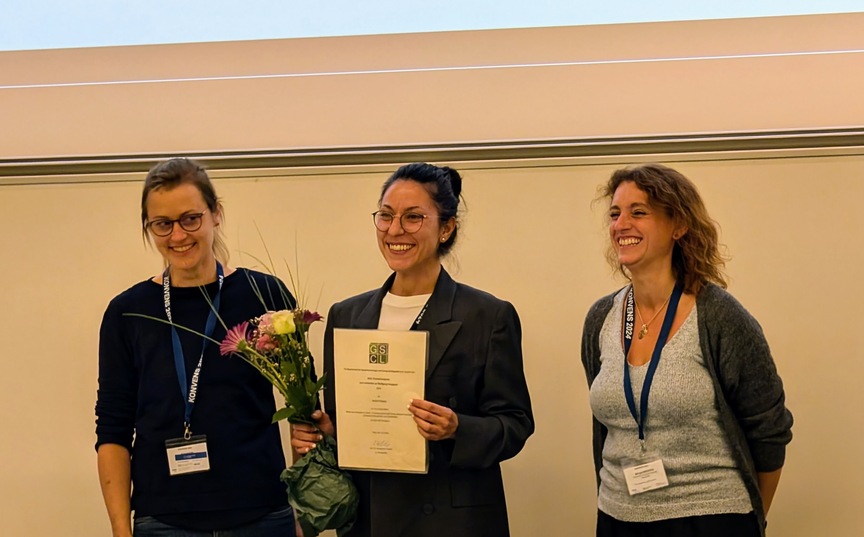
<p>I cannot write this blog post without mentioning that my Ph.D. student
Enrica Troiano won the award of the GSCL for the best thesis in the
years 2023. Her thesis is on bringing event analysis and emotion
analysis together. In contrast to the various papers we wrote, is really
a nice aggregation of the work, and worth reading (<a href="https://elib.uni-stuttgart.de/handle/11682/13671">Troiano
(2023)</a>).</p>

<p><img src="/blog-assets/2024-10-12/enrica.jpg" alt="Enrica Troiano won the GSCL PhD award" /></p>

<h2 id="venue-and-place">Venue and Place</h2>

<p>The conference took place in Vienna - a city I should have visited more
often already. Now, from my new workplace in Bamberg, this is reachable
with a short train trip (4 hours from Nurnberg). Of course, I brought my
bicycle, so I could commute from the hotel to the conference venue by
bike. Unfortunately, there was a storm and rain warning, so towards the
end, cycling around became a bit challenging. Actually, when I traveled
back, I took one of the last three trains that made it to Germany,
before the track was shut down for a couple of days. Read more about
this storm <a href="https://orf.at/stories/3371586/">here</a>.</p>

<p>The conference itself took place at the University of Vienna, in a
pretty modern lecture hall. The poster sessions were right in the lobby,
so no long commutes between places for various parts of the program.</p>

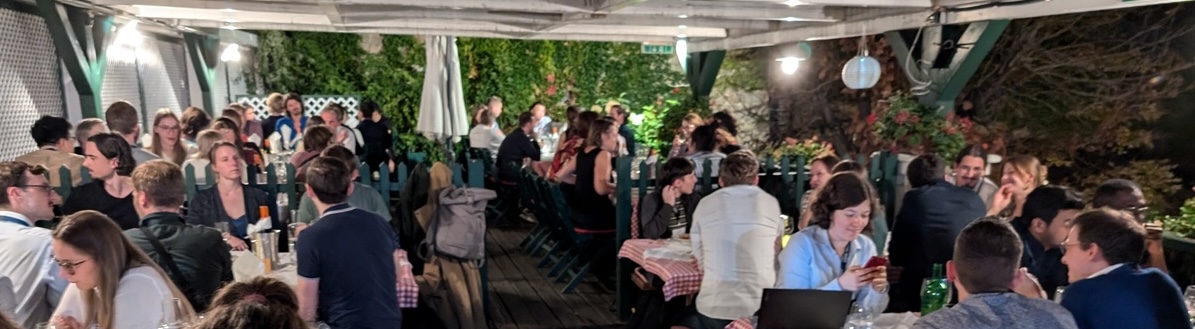
<p>The social event was a small walk through the vineyards and dinner in a
beergarden. I prefer more vegetarian-friendly places and non-seated
dinners at conferences, but the place was very nice.</p>

<p><img src="/blog-assets/2024-10-12/social.jpg" alt="Social Event" /></p>

<h1 id="bibliography">Bibliography</h1>

<p>Gross, Stephanie, Brigitte Krenn, Craig Lincoln, and Lena Holzwarth. 2024. “Analysing Effects of Inducing Gender Bias in Language Models.” In
<em>Proceedings of the 20th Conference on Natural Language Processing (KONVENS 2024)</em>, edited by Pedro Henrique Luz de Araujo, Andreas
Baumann, Dagmar Gromann, Brigitte Krenn, Benjamin Roth, and Michael Wiegand, 222–30. Vienna, Austria: Association for Computational
Linguistics. <a href="https://aclanthology.org/2024.konvens-main.24">https://aclanthology.org/2024.konvens-main.24</a>.</p>

<p>Hellwig, Nils Constantin, Jakob Fehle, Markus Bink, and Christian
Wolff. 2024. “GERestaurant: A German Dataset of Annotated Restaurant Reviews
for Aspect-Based Sentiment Analysis.” In <em>Proceedings of the 20th
Conference on Natural Language Processing (KONVENS 2024)</em>, edited by
Pedro Henrique Luz de Araujo, Andreas Baumann, Dagmar Gromann, Brigitte
Krenn, Benjamin Roth, and Michael Wiegand, 123–33. Vienna, Austria:
Association for Computational Linguistics.
<a href="https://aclanthology.org/2024.konvens-main.14">https://aclanthology.org/2024.konvens-main.14</a>.</p>

<p>Kim, Najoung, and Sebastian Schuster. 2023. “Entity Tracking in Language
Models.” In <em>Proceedings of the 61st Annual Meeting of the Association
for Computational Linguistics (Volume 1: Long Papers)</em>, edited by Anna
Rogers, Jordan Boyd-Graber, and Naoaki Okazaki, 3835–55. Toronto,
Canada: Association for Computational Linguistics.
<a href="https://doi.org/10.18653/v1/2023.acl-long.213">https://doi.org/10.18653/v1/2023.acl-long.213</a>.</p>

<p>Klinger, Roman, and Philipp Cimiano. 2014. “The USAGE Review Corpus for
Fine Grained Multi Lingual Opinion Analysis.” In <em>Proceedings of the
Ninth International Conference on Language Resources and Evaluation
(LREC’14)</em>, edited by Nicoletta Calzolari, Khalid Choukri, Thierry
Declerck, Hrafn Loftsson, Bente Maegaard, Joseph Mariani, Asuncion
Moreno, Jan Odijk, and Stelios Piperidis, 2211–18. Reykjavik, Iceland:
European Language Resources Association (ELRA).
<a href="http://www.lrec-conf.org/proceedings/lrec2014/pdf/85_Paper.pdf">http://www.lrec-conf.org/proceedings/lrec2014/pdf/85_Paper.pdf</a>.</p>

<p>Kluge, Lisa, and Maximilian Kähler. 2024. “Few-Shot Prompting for
Subject Indexing of German Medical Book Titles.” In <em>Proceedings of
the 20th Conference on Natural Language Processing (KONVENS 2024)</em>, edited
by Pedro Henrique Luz de Araujo, Andreas Baumann, Dagmar Gromann,
Brigitte Krenn, Benjamin Roth, and Michael Wiegand, 141–48. Vienna,
Austria: Association for Computational Linguistics.
<a href="https://aclanthology.org/2024.konvens-main.16">https://aclanthology.org/2024.konvens-main.16</a>.</p>

<p>Papay, Sean, and Sebastian Padó. 2020. “RiQuA: A Corpus of Rich
Quotation Annotation for English Literary Text.” In <em>Proceedings of the
Twelfth Language Resources and Evaluation Conference</em>, edited by
Nicoletta Calzolari, Frédéric Béchet, Philippe Blache, Khalid Choukri,
Christopher Cieri, Thierry Declerck, Sara Goggi, et al., 835–41.
Marseille, France: European Language Resources Association.
<a href="https://aclanthology.org/2020.lrec-1.104">https://aclanthology.org/2020.lrec-1.104</a>.</p>

<p>Petersen-Frey, Fynn, and Chris Biemann. 2024. “Fine-Grained Quotation
Detection and Attribution in German News Articles.” In <em>Proceedings of
the 20th Conference on Natural Language Processing (KONVENS 2024)</em>,
edited by Pedro Henrique Luz de Araujo, Andreas Baumann, Dagmar Gromann,
Brigitte Krenn, Benjamin Roth, and Michael Wiegand, 196–208. Vienna,
Austria: Association for Computational Linguistics.
<a href="https://aclanthology.org/2024.konvens-main.22">https://aclanthology.org/2024.konvens-main.22</a>.</p>

<p>Sänger, Mario, Ulf Leser, Steffen Kemmerer, Peter Adolphs, and Roman
Klinger. 2016. “SCARE ― the Sentiment Corpus of App Reviews with
Fine-Grained Annotations in German.” In <em>Proceedings of the Tenth
International Conference on Language Resources and Evaluation
(LREC’16)</em>, edited by Nicoletta Calzolari, Khalid Choukri, Thierry
Declerck, Sara Goggi, Marko Grobelnik, Bente Maegaard, Joseph Mariani,
et al., 1114–21. Portorož, Slovenia: European Language Resources
Association (ELRA). <a href="https://aclanthology.org/L16-1178">https://aclanthology.org/L16-1178</a>.</p>

<p>Scheible, Christian, Roman Klinger, and Sebastian Padó. 2016. “Model
Architectures for Quotation Detection.” In <em>Proceedings of the 54th
Annual Meeting of the Association for Computational Linguistics
(Volume 1: Long Papers)</em>, edited by Katrin Erk and Noah A. Smith, 1736–45.
Berlin, Germany: Association for Computational Linguistics.
<a href="https://doi.org/10.18653/v1/P16-1164">https://doi.org/10.18653/v1/P16-1164</a>.</p>

<p>Sun, Tony, Andrew Gaut, Shirlyn Tang, Yuxin Huang, Mai ElSherief, Jieyu
Zhao, Diba Mirza, Elizabeth Belding, Kai-Wei Chang, and William Yang
Wang. 2019. “Mitigating Gender Bias in Natural Language Processing:
Literature Review.” In <em>Proceedings of the 57th Annual Meeting of the
Association for Computational Linguistics</em>, edited by Anna Korhonen,
David Traum, and Lluı́s Màrquez, 1630–40. Florence, Italy: Association
for Computational Linguistics. <a href="https://doi.org/10.18653/v1/P19-1159">https://doi.org/10.18653/v1/P19-1159</a>.</p>

<p>Troiano, Enrica. 2023. “Where Are Emotions in Text? A Human-Based and
Computational Investigation of Emotion Recognition and Generation.” PhD
thesis, University of Stuttgart.
<a href="https://elib.uni-stuttgart.de/handle/11682/13671">https://elib.uni-stuttgart.de/handle/11682/13671</a>.</p>

<p>Zanotto, Sergio E., Diego Frassinelli, and Miriam Butt. 2024. “Language
Complexity in Populist Rhetoric.” In <em>Proceedings of the 4th Workshop on
Computational Linguistics for the Political and Social Sciences: Long
and Short Papers</em>, edited by Christopher Klamm, Gabriella Lapesa, Simone
Paolo Ponzetto, Ines Rehbein, and Indira Sen, 61–80. Vienna, Austria:
Association for Computational Linguistics.
<a href="https://aclanthology.org/2024.cpss-1.5">https://aclanthology.org/2024.cpss-1.5</a>.</p>

<p>[<a href="https://www.romanklinger.de/blog-assets/2024-10-12/konvens-2024-conf-report.pdf">Download this post as
PDF</a>]</p>]]></content><author><name>Roman Klinger</name></author><category term="Conference" /><summary type="html"><![CDATA[KONVENS]]></summary></entry><entry><title type="html">Conference Report: LREC-COLING 2024</title><link href="https://www.romanklinger.de/blog/2023-05-26-lrec-coling/" rel="alternate" type="text/html" title="Conference Report: LREC-COLING 2024" /><published>2024-05-26T00:01:00+02:00</published><updated>2024-05-26T00:01:00+02:00</updated><id>https://www.romanklinger.de/blog/lrec-coling-report</id><content type="html" xml:base="https://www.romanklinger.de/blog/2023-05-26-lrec-coling/"><![CDATA[<p>End of May 2024, I participated in the Joint International Conference on
Computational Linguistics, Language Resources and Evaluation
(<a href="https://lrec-coling-2024.org/">LREC-COLING</a>) in Turin. Both COLING and
LREC enrich the landscape of competitive conferences to publish in
natural language processing and computational linguistics. While ACL,
EMNLP, NAACL and EACL have a tendendency to aim at focusing on accepting
high impact papers, also by keeping the acceptance rate low (~25%), both
COLING and LREC are traditionally more inclusive. COLING and LREC
recently had <a href="https://www.reddit.com/r/MachineLearning/comments/1axvp52/d_was_the_borderline_of_lreccoling_2024_higher/">acceptance
rates</a>
around 28% and 65%, respectively. While COLING also has been a bit
higher in the past, these numbers are generally <a href="https://aclweb.org/aclwiki/Conference_acceptance_rates">pretty
typical</a> for
these venues.</p>

<p><img src="/blog-assets/2024-05-26/conf-s.jpg" alt="Plenary Session" /></p>

<p>The conferences LREC and COLING happened together this year, and the
general chairs explained this to be a one time event to reschedule LREC to
happen every even year and COLING every odd year, while both so far took
place in even years. Joining these two conferences was interesting for
authors who submitted, because it was not really clear what to expect.
Also the organizers seem to have been surprised by the numbers of
submitted papers.</p>

<p>Overall, there have been 3,471 submissions, with 1,554 acceptances. Out
of those 275 were presented in talks, 837 as poster, and 442 remotely.
Therefore, the acceptance rate was 44%. It’s difficult to say, but it
might be that tracks that were more LREC-like had a higher acceptance
rate and more COLING-style tracks had a lower one. I suspect that this
is the case because the track with most acceptances is in the track
“Corpora and Annotation”. LREC’s idea has always been to optimize for
high recall here, given that resources may have an impact in
low-resource languages without showing a high impact overall across the
community. However, I’d like to note that LREC only started in 2020 to
review its papers! Until 2018, extended abstracts were submitted and
reviewed, and accepted abstracts were invited to submit a full paper,
which did not get reviewed again. I am quite happy that this has been
changed. The overall quality of papers, posters, and presentations has
been comparable to other conferences, but before 2018, I’ve seen a
couple of presentations at LREC where a review of the full paper might
have had the chance to improve the quality of the work.</p>

<p>In the opening session, the program chairs also shared information on
the countries from where most papers came (ranked list: China, USA,
German, France, Japan, UK, Rep. of Korea, Spain, Italy, India). While
China is, since a couple of years, having more and more papers in the
NLP venues, I was a bit surprised to see quite many papers from Korea,
which I think I did not before. Maybe the reason is that COLING 2022 was
in Korea and made the conference more popular in this part of the world.
It’s been quite interesting to also see many papers who worked on
Korean. There were also some differences between countries in the
acceptance rates, but I am not sure if these are just artefacts, so I
don’t want to republish the overall highest numbers of acceptance rates
(because the numbers of submissions were low in these places). The
overall number of submissions is also roughly mirrored in the numbers of
participants: China (472), USA (313), Germany (286), Italy (237), France
(221), UK (143), Japan (141), Korea (91). I was also very happy to see
that there were 89 scholars from Ukraine.</p>

<p>Overall, the conference felt very much like COLING and LREC together -
one could clearly see the origin of this joint conference, and I liked
this a lot.</p>

<p><img src="/blog-assets/2024-05-26/poster-s.jpg" alt="Poster Session" /></p>

<p>As usual in our field, most papers were presented as posters, and
LREC-COLING made no difference regarding the difference between the
quality of orally presented papers and posters: there is none.
Therefore, posters are often much more interactive than presentations,
and its great to have discussions. I still like to go to presentations,
particularly for topics where I am not an expert. For me, oral
presentations are better to learn something new I don’t know a lot
about. I don’t feel comfortable with asking a poster presenter for very
basic introductions while they want to talk about their most recent
research.</p>

<h3 id="tutorials">Tutorials</h3>

<p>For the first time in my life, I’ve been asked to be a tutorial
co-chair. I did act as a senior area chair a couple of times, but that’s
a more guided process. I was very happy to do that together with <a href="https://www.chokkan.org/">Naoaki
Okazaki</a> who had experience already as a
tutorial chair. Without him, I would not have been able to do this job,
I learned a lot from him.</p>

<p>Due to his experience, nearly everything went very well with the
tutorials, as far as I can say. We did select a good set of tutorials
who attracted people from various areas. We received 20 submissions from
which we selected 13 to be taught at the conference. Out of those three
were introductory (one to an adjacent topic), and the majority presented
cutting-edge topics. Unsurprisingly, a popular topic is large-language
models, which are covered by multiple tutorials with varying
perspectives on multimodality, evaluation, knowledge editing and
control, hallucination, and bias. Other tutorials cover argument mining,
semantic web, dialogue systems, semantic parsing, inclusion in NLP
systems, and applications in chemistry. You can find the tutorial
summaries at <a href="https://aclanthology.org/volumes/2024.lrec-tutorials/">Klinger et al.
(2024)</a>. I did
attend two tutorials, one on knowledge editing and one on recognizing
and mitigating hallucinations.</p>

<p>Only one thing did not go well: For one tutorial, the presenters did not
come on site but presented entirely virtual; something that we did not
intend. We believe that we communicated that, for each tutorial, at
least one presenter needed to be on site. It’s currently not clear to me
what the reason for his presumable misunderstanding is, but for future
tutorials, I would suggest to ensure already at submission time to have
people tick a box that they will come to the conference, if the proposal
is accepted. Also, it might be a good idea to check with the local
organizers if the presenters actually registered to the conference early
enough.</p>

<p>Overall, if you participated in the tutorials as a teacher or
participant, let me know if you have any feedback. LREC-COLING will
compile a summary document to be handed over to the next organizing team
and I would make sure to pass along any constructive feedback.</p>

<h2 id="own-contributions-from-bamberg-and-stuttgart">Own Contributions from Bamberg and Stuttgart</h2>

<p>Stuttgart was very well presented in Turin, as usual, but as this was
the first time for me to be at a conference with my Bamberg affiliation,
I will focus on mentioning the contributions that came from Bamberg.</p>

<p>We had two papers in which my group was involved:</p>

<ul>
  <li><a href="https://aclanthology.org/2024.lrec-main.243/">Velutharambath, Wührl, and Klinger
(2024)</a> presents our
Defabel corpus in which we asked people to argue for a given
statement (“Convince me that camels store water in the hump.”)
Depending on their own belief, we labeled the argument as deceptive
or not. By doing so, we have a corpus in which deceptive arguments
and “honest” arguments were created for the same statements. Our
intend was to disentangle fact-checking and deception detection.</li>
  <li><a href="https://aclanthology.org/2024.lrec-main.503/">Wemmer, Labat, and Klinger
(2024)</a> describes the
corpus creation of customer agent and dream corpora annotated with
cumulative emotion labels. Most emotion corpora are either for the
whole text, for isolated sentences, or for sentences in context. We
compiled a corpus with annotations in which the raters only had
access to the <em>prior</em> context, which is the realistic setting how we
also read text or talk to other people – we cannot look into the
future!</li>
</ul>

<p>I was happy to also see another contribution from Bamberg, namely from
the group of <a href="https://www.uni-bamberg.de/minf/">Andreas Henrich</a>:</p>

<ul>
  <li><a href="https://aclanthology.org/2024.determit-1.8/">Fruth, Jegan, and Henrich
(2024)</a> discuss in
their paper published at the “Workshop on DeTermIt! Evaluating Text
Difficulty in a Multilingual Context” a reinforcement learning based
approach to German text simplification. Noteworthy is that they also
tackle hallucination to some degree, namely by checking of any named
entities are included that have not been in the original
non-simplified text.</li>
</ul>

<h2 id="my-favorite-contributions">My Favorite Contributions</h2>

<p>I found quite a set of talks and papers very interesting. This only
reflects my personal opinion, and that I do not mention a particular
paper probably only means that I did not have the time to see its
presentation. There are many interesting papers in the
<a href="https://aclanthology.org/events/lrec-2024/">proceedings</a>, I did not go
through all of them yet.</p>

<h3 id="invited-talks">Invited Talks</h3>

<p>Before I mention my favorite papers, I’d like to say something about the
invited talks. There were three of them with quite different foci. I’ll
mention the two here that I found most interesting.</p>

<p><a href="https://bcs.mit.edu/directory/roger-levy">Roger Levy</a> talked about
mistakes that humans and language models do; in the same way or in
different ways. He also gave possible explanations for both humans and
models. His talk was full of interesting text completion examples, for
instance “The children went outside to…” or “The squirrel stored some
nuts in the…” – where in the latter case apparently many people answer
“tree”.</p>

<p><a href="https://www.rose.uzh.ch/de/seminar/personen/loporcaro.html">Michele
Loporcaro</a>
talked about differences in the dialect in italy. I found this
inspiring, not only because there was barely anything in the talk that I
knew before (not a linguist…), but also because it gave me an
interesting example for linguistic research to which I am not often
enough exposed yet.</p>

<h3 id="papers">Papers</h3>

<p>I found the following papers particularly interesting. I selected these
papers based on my own interests. Given that you read this here on my
blog there is some chance that you share some research interests with me
and hopefully find my selection useful. Still, I want to point out that
it’s absolutely not a negative opinion statement if I did not include a
paper here, despite it being related to my interests. I probably just
missed it.</p>

<p>Biomedical and Health NLP:</p>

<ul>
  <li><a href="https://aclanthology.org/2024.lrec-main.36/">Raithel et al. (2024)</a>
create a pharmacovigilance corpus across multiple languages. It is
annotated with drug names, changes in medication, and side effects,
as well as causal relations. Interestingly, the baseline experiments
also include cross-lingual experiments (training on multiple
languages and testing in a zero-shot setting on another one). The
performance scores are similar to monolingual experiments, sometimes
even higher. The paper might have some overlap to our BEAR corpus,
but we had a different focus, namely the goal to develop an entity
and argumentative claim resource (<a href="https://aclanthology.org/2022.lrec-1.472/">Wührl and Klinger
(2022)</a>,<a href="https://aclanthology.org/2024.eacl-long.124/">Wuehrl et al.
(2024)</a>).</li>
  <li><a href="https://aclanthology.org/2024.determit-1.6/">Giannouris et al.
(2024)</a> describe an
approach in the Determit workshop to automatically summarize
clinical trial reports in plain language. I’ve been interested in
biomedical text summarization for laypeople for a while, and our
<a href="https://www.uni-bamberg.de/en/nlproc/projects/fibiss/">FIBISS
project</a> has
also been motivated with such challenges in mind. They contribute an
interesting and valuable resource on the topic.</li>
</ul>

<p>Ensembles/Aggregations of annotators:</p>

<ul>
  <li><a href="https://aclanthology.org/2024.lrec-main.1169/">Basile, Franco-Salvador, and Rosso
(2024)</a> is a bit of a
demo paper. They present a Bayesian approach to annotator
aggregation with an integration of the <a href="https://mc-stan.org/">STAN</a>
language to specify directed probabilistic models. First of all, I
was quite happy to see some probabilistic graphical model work at
the conference, and secondly, this really looks like a useful
approach. We’ll definitely have a look!</li>
  <li><a href="https://fmplaza.github.io/">Flor Miriam Plaza del Arco</a> presented
work in the NLPerspectives workshop in which she and her colleagues
showed that the annotation-aggregation method MACE can be used to
build ensembles of language models which are better than simpler
aggregation methods, like majority vote (<a href="https://aclanthology.org/2024.nlperspectives-1.2/">Plaza-del-Arco, Nozza, and
Hovy (2024)</a>).
That’s interesting because LLMs are not really diverse as humans
are, but the method still works for aggregation Instruction-tuned
LMs show specialization in different tasks. We talked potential
future work in which the components of the ensemble could be
conditioned on personas to explicitly make the ensemble more diverse
as humans are in annotation tasks. I am curious to see how this
goes!</li>
</ul>

<p><code></code></p>

<p>Corpus collection and Analysis:</p>

<ul>
  <li><a href="https://aclanthology.org/2024.lrec-main.1529/">Jin et al. (2024)</a>
report on their study on bragging in social media. They find that
rich males brag more about their leisure time while low income
people focus more on the self. Very interesting analysis. I am
wondering if these results could impact general social media
happiness analysis.</li>
  <li><a href="https://aclanthology.org/2024.lrec-main.684/">Dick et al. (2024)</a>
describe their collected corpus of various ways to formulate in a
gender-inclusive manner in German. They include comparably known
cases like “Arbeiter:innen”, but also nominalized particles
(Lehrende) and abstract nouns (Lehrkraefte). They collected these
latter cases pretty much manually if I understood their work
correctly. I think that their corpus would be an interesting
resource to build an automatic system that can find unknown and rare
cases of such inclusive language. I sometimes feel a bit challenged
to always formulate gender-inclusive, and I’d like to learn from
other people how they do that in rare, less established cases than
“Studierende”.</li>
  <li><a href="https://aclanthology.org/2024.lrec-main.1448/">Fiorentini, Forlano, and Nese
(2024)</a> create a
corpus of italian WhatsApp messages. An interesing approach: The
authors collected their own whatsapp messages, including voice
messages and asked the interlocutors for consent. The resources
seems not to be available yet, but I am super curious. I remember
that there has been a paper on trust in social media platforms some
while ago and this resource might be an interesting opportunity to
study such effects computationally (<a href="https://www.ncbi.nlm.nih.gov/pmc/articles/PMC7515301/">Nemec Zlatolas et al.
(2019)</a>).</li>
  <li><a href="https://aclanthology.org/2024.lrec-main.292/">Troiano and Vossen
(2024)</a> created the
CLAUSE-ATLAS corpus. They aim at a full (clause-level) annotation of
events and emotions in some books. This can of course not be done
with reasonable costs manually. They therefore only annotate
beginnings of chapter manually and the rest automatically and
analyze the agreement between human annotators and a large language
model. They find that the agreement is comparable.</li>
  <li><a href="https://aclanthology.org/2024.lrec-main.734/">Maladry et al.
(2024)</a> build, to best
of my knowledge, the first irony-labeled corpus in which annotators
were asked for their confidence that the text is actually ironic.
They formulated the labels as a rating scale. Interestingly,
automatic systems are better with predicting irony on the instances
in which humans were confident. That result is in line with our
findings for emotion analysis a couple of years ago (<a href="https://aclanthology.org/2021.wassa-1.5/">Troiano, Padó,
and Klinger (2021)</a>),
where we also showed that humans can quite well predict the
inter-annotator agreement for the instances they annotated.</li>
</ul>

<p>Arguments and News:</p>

<ul>
  <li><a href="https://aclanthology.org/2024.lrec-main.1349/">Feger and Dietze
(2024)</a> build an
argument corpus in which the discussion is kept as a tree. They
label Arguments as Statements and Reasons and Non-arguments as
Notification or None. I think it might be nice to also see
persuasiveness labels for the arguments in comparison to each other
in each tree.</li>
  <li><a href="https://aclanthology.org/2024.lrec-main.1540/">Song and Wang
(2024)</a> build an
automatic system to persuade people, here in a specific context,
namely to make donations. Their system is a chatbot that can
automatically recognize which persuasion strategy might be most
promising. They consider “credibility appeal”, “foot-in-the-door”,
and “emotional appeal”. Again, that’s super relevant for our <a href="https://www.uni-bamberg.de/en/nlproc/projects/emcona/">EMCONA
project</a> and
we’ll consider to use this for our work.</li>
  <li><a href="https://aclanthology.org/2024.lrec-main.1258/">Pu et al. (2024)</a>
built a system to automatically generate news reports out of
scientific texts. Their idea is similar to our analysis in our
recent work in <a href="https://aclanthology.org/2024.eacl-long.124/">Wuehrl et al.
(2024)</a>. Its
impressive that they were able to automatize such complex task! I’d
be curious to understand if their automatic system makes the same
changes to the text and scientific claims that we found (making the
articles more sensational, or simplifying correlation reports to
causations).</li>
  <li><a href="https://aclanthology.org/2024.lrec-main.268/">Nejadgholi et al.
(2024)</a> create
counter-stereotype statements. I put this in this category of
argument mining, because I’d consider counter-stereotype statements
as attempts to convince the dialogue partner to change a stance. The
work is nicely grounded in categories of stereotypes, like
counter-facts and broadening universals. I am also here wondering if
a convincingness study would make sense.</li>
  <li><a href="https://aclanthology.org/2024.lrec-main.923/">Kalashnikova, Vasilescu, and Devillers
(2024)</a> describe a
wizard-of-oz study in which they nudge people carefully to change
their opinion or emotion. They compare smart assistance, robots, and
humans and … human nudges are most successful.</li>
</ul>

<p>LLM-Specific things:</p>

<ul>
  <li><a href="https://aclanthology.org/2024.lrec-main.1462/">Rao et al. (2024)</a>
develop a hierarchy of jailbreak attempts to LLMs. I did not too
much look into possibilities to trick LLM to do things they are
supposed not to do (like to leak training data), and the authors
provide a set of possible approaches. It is interesting to see these
weaknesses of existing models.</li>
  <li><a href="https://aclanthology.org/2024.lrec-main.288/">Addlesee, Lemon, and Eshghi
(2024)</a> describe a
study that showcases possible differences how LLM answer requests to
how humans would do that. Particularly, they put incomplete
questions into a LLM and check if the behaviour is human-like. My
favorite example from the poster was: “What is the zip code of…” and
the LLM answers “of Nevada?”.</li>
  <li><a href="https://aclanthology.org/2024.lrec-main.464/">Pucci, Ranaldi, and Freitas
(2024)</a> report on an
experiment on the importance of the order of instructions with
varying difficulty. Instead of just using answer length or such
proxies to assess the difficulty, they rely on the concept of
Bloom’s taxonomy (remembering, understanding, applying,
creating/evaluating/analyzing) and show that fine-tuning a LLM in
order of these categories in increasing difficulty level leads to
better results. This paper is a beautiful example that imports
knowledge from psychology and humanities into machine learning.</li>
</ul>

<p>Emotions:</p>

<ul>
  <li><a href="https://aclanthology.org/2024.lrec-main.514/">Li, Peng, and Hsu
(2024)</a> describe a
chat system that can help people to regulate emotions. This is the
first work I am aware of that builds on top of emotion regulation
theories. Their system learns that guilt can be tackled with
curiosity, and fear with admiration. Very impressive example of how
an analysis of a data-driven system confirms knowledge that we have
from other fields, confirming the learning approach.</li>
  <li><a href="https://aclanthology.org/2024.lrec-main.1303/">Bhaumik et al.
(2024)</a> describe a
corpus and modeling effort of detecting agendas on social media.
What do people intend with a particular post? I find this related to
our research interest in the
<a href="https://www.uni-bamberg.de/en/nlproc/projects/emcona/">EMCONA</a>
project, in which we want to understand how people use emotions to
persuade people. However, their work is more general and focuses on
agendas that are less explicitly formulated in the annotated task.</li>
  <li><a href="https://aclanthology.org/2024.lrec-main.1059/">Christop (2024)</a>
described her effort on building a speech corpus in Polish, labeled
with emotions. Her intend is to use it later for text-to-speech
systems. The data has been created by asking actors to show specific
given emotional states.</li>
  <li><a href="https://aclanthology.org/2024.lrec-main.506/">Plaza-del-Arco et al.
(2024)</a> nicely
complements my recent paper on the current state of research on
event-centric emotion analysis (<a href="https://aclanthology.org/2023.bigpicture-1.1/">Klinger
(2023)</a>). The
coverage by Flor and her colleagues is much broader than mine, and
they particularly point out the subjective nature of emotions needs
to be considered more. Further, there is quite a large set of
emotion models in psychology that has not been considered yet.</li>
  <li><a href="https://aclanthology.org/2024.lrec-main.752/">Prochnow et al.
(2024)</a> desribe an
(automatically generated) data set of idioms with emotion labels.</li>
  <li><a href="https://aclanthology.org/2024.lrec-main.1282/">Cortal (2024)</a>
reports on an emotion labeled corpus of dreams. Interestingly,
emotions in this dreambank corpus are mostly expressed quite
explicitly. The corpus also contains some semantic role annotations,
making it one of the few corpora with structured emotion
annotations. We also worked on this for a while, with the REMAN and
GoodNewsEveryone corpora (<a href="https://aclanthology.org/C18-1114/">Kim and Klinger
(2018)</a>,<a href="https://aclanthology.org/2020.lrec-1.194/">Bostan, Kim, and
Klinger (2020)</a>), amongst
others. It might be interesting to see how literature and news
annotations compare to those in dreams, and if emotion role labeling
systems could be transferred between these very different domains.</li>
</ul>

<p>Other things:</p>

<ul>
  <li><a href="https://aclanthology.org/2024.lrec-main.322/">Arimoto et al.
(2024)</a> develop a
long-term chat system to study how a perception of intimacy between
the human and the chat agent develops.</li>
  <li><a href="https://aclanthology.org/2024.lrec-main.668/">Jon and Bojar (2024)</a>
use an optimization method to find translations that show a high
evaluation score, but are wrong.</li>
</ul>

<h3 id="awards">Awards</h3>

<p>The Best papers of LREC-COLING are:</p>

<ul>
  <li><a href="https://aclanthology.org/2024.lrec-main.1526/">Bafna et al.
(2024)</a>: “When Your
Cousin Has the Right Connections: Unsupervised Bilingual Lexicon
Induction for Related Data-Imbalanced Languages”</li>
  <li><a href="https://aclanthology.org/2024.lrec-main.1356/">Someya, Yoshida, and Oseki
(2024)</a>: “Targeted
Syntactic Evaluation on the Chomsky Hierarchy”</li>
</ul>

<h2 id="venue-and-place">Venue and Place</h2>

<p>The conference took place in Turin, a nice city which is not too
touristic. It has an acceptable cycling infrastructure which I used to
go from downtown to the conference center every day. The cars seem not
to be used to bicycles yet and did not check at all if there is a bike
when they turned into an intersection, but the infrastructure was
preventing bad incidence. Definitely not a perfect infrastructure, but
much better than in Stuttgart, so I enjoyed cycling in Turin a lot.</p>

<p>The conference center was the old Fiat factory
<a href="https://en.wikipedia.org/wiki/Lingotto">Lingotto</a> which now has, next
to the conference center, also a mall and a car museum. I am not a car
fan, but the test track on the roof was pretty impressive.</p>

<p><img src="/blog-assets/2024-05-26/roof-s.jpg" alt="Lingotto Roof Test Track" /></p>

<p><img src="/blog-assets/2024-05-26/lingotto-s.jpg" alt="Lingotto" /></p>

<p>The conference center itself was pretty nice (and huge!). The poster
sessions were in a separate hall with a lot of space. While the venue
has not been as charming as in Iceland (LREC 2014), Marrakesh (LREC
2008), or Santa Fe (COLING 2018), I enjoyed the venue being close to the
city.</p>

<p>Altogether, I was very happy with the whole conference, and I am looking
forward to the next LREC 2025 and the COLING 2026.</p>

<p><img src="/blog-assets/2024-05-26/team-s.jpg" alt="Organization Team" /></p>

<h1 id="bibliography">Bibliography</h1>

<p>Addlesee, Angus, Oliver Lemon, and Arash Eshghi. 2024. “Clarifying
Completions: Evaluating How LLMs Respond to Incomplete Questions.” In
<em>Proceedings of the 2024 Joint International Conference on Computational
Linguistics, Language Resources and Evaluation (LREC-COLING 2024)</em>,
edited by Nicoletta Calzolari, Min-Yen Kan, Veronique Hoste, Alessandro
Lenci, Sakriani Sakti, and Nianwen Xue, 3242–49. Torino, Italia: ELRA;
ICCL. <a href="https://aclanthology.org/2024.lrec-main.288">https://aclanthology.org/2024.lrec-main.288</a>.</p>

<p>Arimoto, Tsunehiro, Hiroaki Sugiyama, Hiromi Narimatsu, and Masahiro
Mizukami. 2024. “Comparison of the Intimacy Process Between Real and
Acting-Based Long-Term Text Chats.” In <em>Proceedings of the 2024 Joint
International Conference on Computational Linguistics, Language
Resources and Evaluation (LREC-COLING 2024)</em>, edited by Nicoletta
Calzolari, Min-Yen Kan, Veronique Hoste, Alessandro Lenci, Sakriani
Sakti, and Nianwen Xue, 3639–44. Torino, Italia: ELRA; ICCL.
<a href="https://aclanthology.org/2024.lrec-main.322">https://aclanthology.org/2024.lrec-main.322</a>.</p>

<p>Bafna, Niyati, Cristina España-Bonet, Josef van Genabith, Benoı̂t Sagot,
and Rachel Bawden. 2024. “When Your Cousin Has the Right Connections:
Unsupervised Bilingual Lexicon Induction for Related Data-Imbalanced
Languages.” In <em>Proceedings of the 2024 Joint International Conference
on Computational Linguistics, Language Resources and Evaluation
(LREC-COLING 2024)</em>, edited by Nicoletta Calzolari, Min-Yen Kan,
Veronique Hoste, Alessandro Lenci, Sakriani Sakti, and Nianwen Xue,
17544–56. Torino, Italia: ELRA; ICCL.
<a href="https://aclanthology.org/2024.lrec-main.1526">https://aclanthology.org/2024.lrec-main.1526</a>.</p>

<p>Basile, Angelo, Marc Franco-Salvador, and Paolo Rosso. 2024. “PyRater: A
Python Toolkit for Annotation Analysis.” In <em>Proceedings of the 2024
Joint International Conference on Computational Linguistics, Language
Resources and Evaluation (LREC-COLING 2024)</em>, edited by Nicoletta
Calzolari, Min-Yen Kan, Veronique Hoste, Alessandro Lenci, Sakriani
Sakti, and Nianwen Xue, 13356–62. Torino, Italia: ELRA; ICCL.
<a href="https://aclanthology.org/2024.lrec-main.1169">https://aclanthology.org/2024.lrec-main.1169</a>.</p>

<p>Bhaumik, Ankita, Ning Sa, Gregorios Katsios, and Tomek Strzalkowski. 2024. “Social Convos: Capturing Agendas and Emotions on Social Media.”
In <em>Proceedings of the 2024 Joint International Conference on
Computational Linguistics, Language Resources and Evaluation
(LREC-COLING 2024)</em>, edited by Nicoletta Calzolari, Min-Yen Kan,
Veronique Hoste, Alessandro Lenci, Sakriani Sakti, and Nianwen Xue,
14984–94. Torino, Italia: ELRA; ICCL.
<a href="https://aclanthology.org/2024.lrec-main.1303">https://aclanthology.org/2024.lrec-main.1303</a>.</p>

<p>Bostan, Laura Ana Maria, Evgeny Kim, and Roman Klinger. 2020.
“GoodNewsEveryone: A Corpus of News Headlines Annotated with Emotions,
Semantic Roles, and Reader Perception.” In <em>Proceedings of the Twelfth
Language Resources and Evaluation Conference</em>, edited by Nicoletta
Calzolari, Frédéric Béchet, Philippe Blache, Khalid Choukri, Christopher
Cieri, Thierry Declerck, Sara Goggi, et al., 1554–66. Marseille, France:
European Language Resources Association.
<a href="https://aclanthology.org/2020.lrec-1.194">https://aclanthology.org/2020.lrec-1.194</a>.</p>

<p>Christop, Iwona. 2024. “NEMO: Dataset of Emotional Speech in Polish.” In
<em>Proceedings of the 2024 Joint International Conference on Computational
Linguistics, Language Resources and Evaluation (LREC-COLING 2024)</em>,
edited by Nicoletta Calzolari, Min-Yen Kan, Veronique Hoste, Alessandro
Lenci, Sakriani Sakti, and Nianwen Xue, 12111–16. Torino, Italia: ELRA;
ICCL. <a href="https://aclanthology.org/2024.lrec-main.1059">https://aclanthology.org/2024.lrec-main.1059</a>.</p>

<p>Cortal, Gustave. 2024. “Sequence-to-Sequence Language Models for
Character and Emotion Detection in Dream Narratives.” In <em>Proceedings of
the 2024 Joint International Conference on Computational Linguistics,
Language Resources and Evaluation (LREC-COLING 2024)</em>, edited by
Nicoletta Calzolari, Min-Yen Kan, Veronique Hoste, Alessandro Lenci,
Sakriani Sakti, and Nianwen Xue, 14717–28. Torino, Italia: ELRA; ICCL.
<a href="https://aclanthology.org/2024.lrec-main.1282">https://aclanthology.org/2024.lrec-main.1282</a>.</p>

<p>Dick, Anna-Katharina, Matthias Drews, Valentin Pickard, and Victoria
Pierz. 2024. “GIL-GALaD: Gender Inclusive Language - German
Auto-Assembled Large Database.” In <em>Proceedings of the 2024 Joint
International Conference on Computational Linguistics, Language
Resources and Evaluation (LREC-COLING 2024)</em>, edited by Nicoletta
Calzolari, Min-Yen Kan, Veronique Hoste, Alessandro Lenci, Sakriani
Sakti, and Nianwen Xue, 7740–45. Torino, Italia: ELRA; ICCL.
<a href="https://aclanthology.org/2024.lrec-main.684">https://aclanthology.org/2024.lrec-main.684</a>.</p>

<p>Feger, Marc, and Stefan Dietze. 2024. “TACO – Twitter Arguments from
COnversations.” In <em>Proceedings of the 2024 Joint International
Conference on Computational Linguistics, Language Resources and
Evaluation (LREC-COLING 2024)</em>, edited by Nicoletta Calzolari, Min-Yen
Kan, Veronique Hoste, Alessandro Lenci, Sakriani Sakti, and Nianwen Xue,
15522–29. Torino, Italia: ELRA; ICCL.
<a href="https://aclanthology.org/2024.lrec-main.1349">https://aclanthology.org/2024.lrec-main.1349</a>.</p>

<p>Fiorentini, Ilaria, Marco Forlano, and Nicholas Nese. 2024. “Towards the
WhAP Corpus: A Resource for the Study of Italian on WhatsApp.” In
<em>Proceedings of the 2024 Joint International Conference on Computational
Linguistics, Language Resources and Evaluation (LREC-COLING 2024)</em>,
edited by Nicoletta Calzolari, Min-Yen Kan, Veronique Hoste, Alessandro
Lenci, Sakriani Sakti, and Nianwen Xue, 16659–63. Torino, Italia: ELRA;
ICCL. <a href="https://aclanthology.org/2024.lrec-main.1448">https://aclanthology.org/2024.lrec-main.1448</a>.</p>

<p>Fruth, Leon, Robin Jegan, and Andreas Henrich. 2024. “An Approach
Towards Unsupervised Text Simplification on Paragraph-Level for German
Texts.” In <em>Proceedings of the Workshop on DeTermIt! Evaluating Text
Difficulty in a Multilingual Context @ LREC-COLING 2024</em>, edited by
Giorgio Maria Di Nunzio, Federica Vezzani, Liana Ermakova, Hosein
Azarbonyad, and Jaap Kamps, 77–89. Torino, Italia: ELRA; ICCL.
<a href="https://aclanthology.org/2024.determit-1.8">https://aclanthology.org/2024.determit-1.8</a>.</p>

<p>Giannouris, Polydoros, Theodoros Myridis, Tatiana Passali, and Grigorios
Tsoumakas. 2024. “Plain Language Summarization of Clinical Trials.” In
<em>Proceedings of the Workshop on DeTermIt! Evaluating Text Difficulty in
a Multilingual Context @ LREC-COLING 2024</em>, edited by Giorgio Maria Di
Nunzio, Federica Vezzani, Liana Ermakova, Hosein Azarbonyad, and Jaap
Kamps, 60–67. Torino, Italia: ELRA; ICCL.
<a href="https://aclanthology.org/2024.determit-1.6">https://aclanthology.org/2024.determit-1.6</a>.</p>

<p>Jin, Mali, Daniel Preotiuc-Pietro, A. Seza Doğruöz, and Nikolaos
Aletras. 2024. “Who Is Bragging More Online? A Large Scale Analysis of
Bragging in Social Media.” In <em>Proceedings of the 2024 Joint
International Conference on Computational Linguistics, Language
Resources and Evaluation (LREC-COLING 2024)</em>, edited by Nicoletta
Calzolari, Min-Yen Kan, Veronique Hoste, Alessandro Lenci, Sakriani
Sakti, and Nianwen Xue, 17575–87. Torino, Italia: ELRA; ICCL.
<a href="https://aclanthology.org/2024.lrec-main.1529">https://aclanthology.org/2024.lrec-main.1529</a>.</p>

<p>Jon, Josef, and Ondřej Bojar. 2024. “GAATME: A Genetic Algorithm for
Adversarial Translation Metrics Evaluation.” In <em>Proceedings of the 2024
Joint International Conference on Computational Linguistics, Language
Resources and Evaluation (LREC-COLING 2024)</em>, edited by Nicoletta
Calzolari, Min-Yen Kan, Veronique Hoste, Alessandro Lenci, Sakriani
Sakti, and Nianwen Xue, 7562–69. Torino, Italia: ELRA; ICCL.
<a href="https://aclanthology.org/2024.lrec-main.668">https://aclanthology.org/2024.lrec-main.668</a>.</p>

<p>Kalashnikova, Natalia, Ioana Vasilescu, and Laurence Devillers. 2024.
“Linguistic Nudges and Verbal Interaction with Robots, Smart-Speakers,
and Humans.” In <em>Proceedings of the 2024 Joint International Conference
on Computational Linguistics, Language Resources and Evaluation
(LREC-COLING 2024)</em>, edited by Nicoletta Calzolari, Min-Yen Kan,
Veronique Hoste, Alessandro Lenci, Sakriani Sakti, and Nianwen Xue,
10555–64. Torino, Italia: ELRA; ICCL.
<a href="https://aclanthology.org/2024.lrec-main.923">https://aclanthology.org/2024.lrec-main.923</a>.</p>

<p>Kim, Evgeny, and Roman Klinger. 2018. “Who Feels What and Why?
Annotation of a Literature Corpus with Semantic Roles of Emotions.” In
<em>Proceedings of the 27th International Conference on Computational
Linguistics</em>, edited by Emily M. Bender, Leon Derczynski, and Pierre
Isabelle, 1345–59. Santa Fe, New Mexico, USA: Association for
Computational Linguistics. <a href="https://aclanthology.org/C18-1114">https://aclanthology.org/C18-1114</a>.</p>

<p>Klinger, Roman. 2023. “Where Are We in Event-Centric Emotion Analysis?
Bridging Emotion Role Labeling and Appraisal-Based Approaches.” In
<em>Proceedings of the Big Picture Workshop</em>, edited by Yanai Elazar,
Allyson Ettinger, Nora Kassner, Sebastian Ruder, and Noah A. Smith,
1–17. Singapore: Association for Computational Linguistics.
<a href="https://doi.org/10.18653/v1/2023.bigpicture-1.1">https://doi.org/10.18653/v1/2023.bigpicture-1.1</a>.</p>

<p>Klinger, Roman, Naozaki Okazaki, Nicoletta Calzolari, and Min-Yen Kan,
eds. 2024. <em>Proceedings of the 2024 Joint International Conference on
Computational Linguistics, Language Resources and Evaluation
(LREC-COLING 2024): Tutorial Summaries</em>. Torino, Italia: ELRA; ICCL.
<a href="https://aclanthology.org/2024.lrec-tutorials.0">https://aclanthology.org/2024.lrec-tutorials.0</a>.</p>

<p>Li, Junlin, Bo Peng, and Yu-Yin Hsu. 2024. “Emstremo: Adapting Emotional
Support Response with Enhanced Emotion-Strategy Integrated Selection.”
In <em>Proceedings of the 2024 Joint International Conference on
Computational Linguistics, Language Resources and Evaluation
(LREC-COLING 2024)</em>, edited by Nicoletta Calzolari, Min-Yen Kan,
Veronique Hoste, Alessandro Lenci, Sakriani Sakti, and Nianwen Xue,
5794–5805. Torino, Italia: ELRA; ICCL.
<a href="https://aclanthology.org/2024.lrec-main.514">https://aclanthology.org/2024.lrec-main.514</a>.</p>

<p>Maladry, Aaron, Alessandra Teresa Cignarella, Els Lefever, Cynthia van
Hee, and Veronique Hoste. 2024. “Human and System Perspectives on the
Expression of Irony: An Analysis of Likelihood Labels and Rationales.”
In <em>Proceedings of the 2024 Joint International Conference on
Computational Linguistics, Language Resources and Evaluation
(LREC-COLING 2024)</em>, edited by Nicoletta Calzolari, Min-Yen Kan,
Veronique Hoste, Alessandro Lenci, Sakriani Sakti, and Nianwen Xue,
8372–82. Torino, Italia: ELRA; ICCL.
<a href="https://aclanthology.org/2024.lrec-main.734">https://aclanthology.org/2024.lrec-main.734</a>.</p>

<p>Nejadgholi, Isar, Kathleen C. Fraser, Anna Kerkhof, and Svetlana
Kiritchenko. 2024. “Challenging Negative Gender Stereotypes: A Study on
the Effectiveness of Automated Counter-Stereotypes.” In <em>Proceedings of
the 2024 Joint International Conference on Computational Linguistics,
Language Resources and Evaluation (LREC-COLING 2024)</em>, edited by
Nicoletta Calzolari, Min-Yen Kan, Veronique Hoste, Alessandro Lenci,
Sakriani Sakti, and Nianwen Xue, 3005–15. Torino, Italia: ELRA; ICCL.
<a href="https://aclanthology.org/2024.lrec-main.268">https://aclanthology.org/2024.lrec-main.268</a>.</p>

<p>Nemec Zlatolas, L., T. Welzer, M. lbl, M. ko, and A. ć. 2019.
“<span class="nocase">A Model of Perception of Privacy, Trust, and
Self-Disclosure on Online Social Networks</span>.” <em>Entropy (Basel)</em> 21
(8).</p>

<p>Plaza-del-Arco, Flor Miriam, Alba A. Cercas Curry, Amanda Cercas Curry,
and Dirk Hovy. 2024. “Emotion Analysis in NLP: Trends, Gaps and Roadmap
for Future Directions.” In <em>Proceedings of the 2024 Joint International
Conference on Computational Linguistics, Language Resources and
Evaluation (LREC-COLING 2024)</em>, edited by Nicoletta Calzolari, Min-Yen
Kan, Veronique Hoste, Alessandro Lenci, Sakriani Sakti, and Nianwen Xue,
5696–5710. Torino, Italia: ELRA; ICCL.
<a href="https://aclanthology.org/2024.lrec-main.506">https://aclanthology.org/2024.lrec-main.506</a>.</p>

<p>Plaza-del-Arco, Flor Miriam, Debora Nozza, and Dirk Hovy. 2024. “Wisdom
of Instruction-Tuned Language Model Crowds. Exploring Model Label
Variation.” In <em>Proceedings of the 3rd Workshop on Perspectivist
Approaches to NLP (NLPerspectives) @ LREC-COLING 2024</em>, edited by Gavin
Abercrombie, Valerio Basile, Davide Bernadi, Shiran Dudy, Simona Frenda,
Lucy Havens, and Sara Tonelli, 19–30. Torino, Italia: ELRA; ICCL.
<a href="https://aclanthology.org/2024.nlperspectives-1.2">https://aclanthology.org/2024.nlperspectives-1.2</a>.</p>

<p>Prochnow, Alexander, Johannes E. Bendler, Caroline Lange, Foivos Ioannis
Tzavellos, Bas Marco Göritzer, Marijn ten Thij, and Riza
Batista-Navarro. 2024. “IDEM: The IDioms with EMotions Dataset for
Emotion Recognition.” In <em>Proceedings of the 2024 Joint International
Conference on Computational Linguistics, Language Resources and
Evaluation (LREC-COLING 2024)</em>, edited by Nicoletta Calzolari, Min-Yen
Kan, Veronique Hoste, Alessandro Lenci, Sakriani Sakti, and Nianwen Xue,
8569–79. Torino, Italia: ELRA; ICCL.
<a href="https://aclanthology.org/2024.lrec-main.752">https://aclanthology.org/2024.lrec-main.752</a>.</p>

<p>Pu, Dongqi, Yifan Wang, Jia E. Loy, and Vera Demberg. 2024. “SciNews:
From Scholarly Complexities to Public Narratives – a Dataset for
Scientific News Report Generation.” In <em>Proceedings of the 2024 Joint
International Conference on Computational Linguistics, Language
Resources and Evaluation (LREC-COLING 2024)</em>, edited by Nicoletta
Calzolari, Min-Yen Kan, Veronique Hoste, Alessandro Lenci, Sakriani
Sakti, and Nianwen Xue, 14429–44. Torino, Italia: ELRA; ICCL.
<a href="https://aclanthology.org/2024.lrec-main.1258">https://aclanthology.org/2024.lrec-main.1258</a>.</p>

<p>Pucci, Giulia, Leonardo Ranaldi, and Andres Freitas. 2024. “Does the
Order Matter? Curriculum Learning over Languages.” In <em>Proceedings of
the 2024 Joint International Conference on Computational Linguistics,
Language Resources and Evaluation (LREC-COLING 2024)</em>, edited by
Nicoletta Calzolari, Min-Yen Kan, Veronique Hoste, Alessandro Lenci,
Sakriani Sakti, and Nianwen Xue, 5212–20. Torino, Italia: ELRA; ICCL.
<a href="https://aclanthology.org/2024.lrec-main.464">https://aclanthology.org/2024.lrec-main.464</a>.</p>

<p>Raithel, Lisa, Hui-Syuan Yeh, Shuntaro Yada, Cyril Grouin, Thomas
Lavergne, Aurélie Névéol, Patrick Paroubek, et al. 2024. “A Dataset for
Pharmacovigilance in German, French, and Japanese: Annotating Adverse
Drug Reactions Across Languages.” In <em>Proceedings of the 2024 Joint
International Conference on Computational Linguistics, Language
Resources and Evaluation (LREC-COLING 2024)</em>, edited by Nicoletta
Calzolari, Min-Yen Kan, Veronique Hoste, Alessandro Lenci, Sakriani
Sakti, and Nianwen Xue, 395–414. Torino, Italia: ELRA; ICCL.
<a href="https://aclanthology.org/2024.lrec-main.36">https://aclanthology.org/2024.lrec-main.36</a>.</p>

<p>Rao, Abhinav Sukumar, Atharva Roshan Naik, Sachin Vashistha, Somak
Aditya, and Monojit Choudhury. 2024. “Tricking LLMs into Disobedience:
Formalizing, Analyzing, and Detecting Jailbreaks.” In <em>Proceedings of
the 2024 Joint International Conference on Computational Linguistics,
Language Resources and Evaluation (LREC-COLING 2024)</em>, edited by
Nicoletta Calzolari, Min-Yen Kan, Veronique Hoste, Alessandro Lenci,
Sakriani Sakti, and Nianwen Xue, 16802–30. Torino, Italia: ELRA; ICCL.
<a href="https://aclanthology.org/2024.lrec-main.1462">https://aclanthology.org/2024.lrec-main.1462</a>.</p>

<p>Someya, Taiga, Ryo Yoshida, and Yohei Oseki. 2024. “Targeted Syntactic
Evaluation on the Chomsky Hierarchy.” In <em>Proceedings of the 2024 Joint
International Conference on Computational Linguistics, Language
Resources and Evaluation (LREC-COLING 2024)</em>, edited by Nicoletta
Calzolari, Min-Yen Kan, Veronique Hoste, Alessandro Lenci, Sakriani
Sakti, and Nianwen Xue, 15595–605. Torino, Italia: ELRA; ICCL.
<a href="https://aclanthology.org/2024.lrec-main.1356">https://aclanthology.org/2024.lrec-main.1356</a>.</p>

<p>Song, Yuhan, and Houfeng Wang. 2024. “Would You Like to Make a Donation?
A Dialogue System to Persuade You to Donate.” In <em>Proceedings of the
2024 Joint International Conference on Computational Linguistics,
Language Resources and Evaluation (LREC-COLING 2024)</em>, edited by
Nicoletta Calzolari, Min-Yen Kan, Veronique Hoste, Alessandro Lenci,
Sakriani Sakti, and Nianwen Xue, 17707–17. Torino, Italia: ELRA; ICCL.
<a href="https://aclanthology.org/2024.lrec-main.1540">https://aclanthology.org/2024.lrec-main.1540</a>.</p>

<p>Troiano, Enrica, Sebastian Padó, and Roman Klinger. 2021. “Emotion
Ratings: How Intensity, Annotation Confidence and Agreements Are
Entangled.” In <em>Proceedings of the Eleventh Workshop on Computational
Approaches to Subjectivity, Sentiment and Social Media Analysis</em>, edited
by Orphee De Clercq, Alexandra Balahur, Joao Sedoc, Valentin Barriere,
Shabnam Tafreshi, Sven Buechel, and Veronique Hoste, 40–49. Online:
Association for Computational Linguistics.
<a href="https://aclanthology.org/2021.wassa-1.5">https://aclanthology.org/2021.wassa-1.5</a>.</p>

<p>Troiano, Enrica, and Piek T. J. M. Vossen. 2024. “CLAUSE-ATLAS: A Corpus
of Narrative Information to Scale up Computational Literary Analysis.”
In <em>Proceedings of the 2024 Joint International Conference on
Computational Linguistics, Language Resources and Evaluation
(LREC-COLING 2024)</em>, edited by Nicoletta Calzolari, Min-Yen Kan,
Veronique Hoste, Alessandro Lenci, Sakriani Sakti, and Nianwen Xue,
3283–96. Torino, Italia: ELRA; ICCL.
<a href="https://aclanthology.org/2024.lrec-main.292">https://aclanthology.org/2024.lrec-main.292</a>.</p>

<p>Velutharambath, Aswathy, Amelie Wührl, and Roman Klinger. 2024. “Can
Factual Statements Be Deceptive? The DeFaBel Corpus of Belief-Based
Deception.” In <em>Proceedings of the 2024 Joint International Conference
on Computational Linguistics, Language Resources and Evaluation
(LREC-COLING 2024)</em>, edited by Nicoletta Calzolari, Min-Yen Kan,
Veronique Hoste, Alessandro Lenci, Sakriani Sakti, and Nianwen Xue,
2708–23. Torino, Italia: ELRA; ICCL.
<a href="https://aclanthology.org/2024.lrec-main.243">https://aclanthology.org/2024.lrec-main.243</a>.</p>

<p>Wemmer, Eileen, Sofie Labat, and Roman Klinger. 2024. “EmoProgress:
Cumulated Emotion Progression Analysis in Dreams and Customer Service
Dialogues.” In <em>Proceedings of the 2024 Joint International Conference
on Computational Linguistics, Language Resources and Evaluation
(LREC-COLING 2024)</em>, edited by Nicoletta Calzolari, Min-Yen Kan,
Veronique Hoste, Alessandro Lenci, Sakriani Sakti, and Nianwen Xue,
5660–77. Torino, Italia: ELRA; ICCL.
<a href="https://aclanthology.org/2024.lrec-main.503">https://aclanthology.org/2024.lrec-main.503</a>.</p>

<p>Wuehrl, Amelie, Yarik Menchaca Resendiz, Lara Grimminger, and Roman
Klinger. 2024. “What Makes Medical Claims (Un)verifiable? Analyzing
Entity and Relation Properties for Fact Verification.” In <em>Proceedings
of the 18th Conference of the European Chapter of the Association for
Computational Linguistics (Volume 1: Long Papers)</em>, edited by Yvette
Graham and Matthew Purver, 2046–58. St. Julian’s, Malta: Association for
Computational Linguistics.
<a href="https://aclanthology.org/2024.eacl-long.124">https://aclanthology.org/2024.eacl-long.124</a>.</p>

<p>Wührl, Amelie, and Roman Klinger. 2022. “Recovering Patient Journeys: A
Corpus of Biomedical Entities and Relations on Twitter (BEAR).” In
<em>Proceedings of the Thirteenth Language Resources and Evaluation
Conference</em>, edited by Nicoletta Calzolari, Frédéric Béchet, Philippe
Blache, Khalid Choukri, Christopher Cieri, Thierry Declerck, Sara Goggi,
et al., 4439–50. Marseille, France: European Language Resources
Association. <a href="https://aclanthology.org/2022.lrec-1.472">https://aclanthology.org/2022.lrec-1.472</a>.</p>

<p>[<a href="https://www.romanklinger.de/blog-assets/2024-05-26/lrec-coling-2024-conf-report.pdf">Download this post as
PDF</a>]</p>]]></content><author><name>Roman Klinger</name></author><category term="Conference" /><summary type="html"><![CDATA[End of May 2024, I participated in the Joint International Conference on Computational Linguistics, Language Resources and Evaluation (LREC-COLING) in Turin. Both COLING and LREC enrich the landscape of competitive conferences to publish in natural language processing and computational linguistics. While ACL, EMNLP, NAACL and EACL have a tendendency to aim at focusing on accepting high impact papers, also by keeping the acceptance rate low (~25%), both COLING and LREC are traditionally more inclusive. COLING and LREC recently had acceptance rates around 28% and 65%, respectively. While COLING also has been a bit higher in the past, these numbers are generally pretty typical for these venues.]]></summary></entry><entry><title type="html">How to apply to a researcher position</title><link href="https://www.romanklinger.de/blog/2023-12-24-how-to-apply/" rel="alternate" type="text/html" title="How to apply to a researcher position" /><published>2023-12-24T09:00:00+01:00</published><updated>2023-12-24T09:00:00+01:00</updated><id>https://www.romanklinger.de/blog/howtoapply</id><content type="html" xml:base="https://www.romanklinger.de/blog/2023-12-24-how-to-apply/"><![CDATA[<p>The process to apply for positions at Universities differs a lot between different countries. I wrote some observations what’s special about the German system in a <a href="/blog/2023-06-02-academic-system-in-germany/">previous post</a>. One particular aspect of the German system is that there are rarely “Ph.D. programs”. You apply for a researcher position which is funded by some source (a third-party funded research project, or a university-funded position, or something else). There is rarely a centrally organized admission process. Essentially, you directly apply to your potential Ph.D. supervisor, and this person will decide who to hire.</p>

<p>Now, <a href="/blog/2023-12-08-bamberg/">after I decided to move to Bamberg</a>, I have some positions to offer. I’d like to provide some guideance what distinguishes a good from a not-so-good application.</p>

<h2 id="does-your-application-look-like-you-send-it-like-that-to-multiple-places">Does your application look like you send it like that to multiple places?</h2>

<p>It is totally understandable that you apply to multiple positions. Nevertheless, make your application appear to be tailored exactly for the position you are applying for. Address the correct person, mention the correct place, but less obvious: Really explain why you apply for this position at this university, with this supervisor. For instance, formulations like “your esteemed institution” or “after a long period of research where to apply” or “your PhD program” sound not very targeted.</p>

<p>Some anecdotes: I received applications which mentioned the wrong name in the letter, I received applications from people who work in entirely different research areas (like… chemistry), and I received applications which mention the wrong University.</p>

<h2 id="the-application-explains-why-you-are-interested-in-this-position">The application explains why you are interested in this position.</h2>

<p>Explain why you are interested in this position. The supervisor wants somebody who is really interested in this job. The supervisor probably developed a research plan for this job to get money for the project, and is very likely super-excited about the ideas. The candidate should, given the little information they have access to, at least show some enthusiasm. If you need more information, ask the person you are applying to. Showing your interest in this particular project is probably more important than your past work. That’s also important, but for a different reason.</p>

<p>Again, some anecdotes: I sometimes receive applications which explain why the position is a good opportunity to develop. The candidates explain that such Ph.D. position helps them to do X or Y, and that it will make them an independent researcher. That’s not unimportant, it’s good to see that you have such goals. But these things are, again, not very targeted.</p>

<h2 id="the-application-explains-your-qualification-for-the-position">The application explains your qualification for the position.</h2>

<p>It is important that you are genuinely interested in the position you apply for. Your supervisor wants to share the enthusiasm of the research with you, but of course they also want you to be able to succeed. For that, they want to know why and how you are qualified. Which previous work made you the ideal candidate for this position? Do not just list everything you did. Explain why some specific experience will be valuable for the position you are applying for.</p>

<p>For instance, if you apply with me for an emotion analysis from literature position (nope, none open in the moment, sorry), it is not that relevant to hear about your experience in text–to–image generation. If you wrote a paper about it, that might, however be relevant, because experience in writing papers generalizes across concrete fields. Try to be as specific as you can. It’s also not terrible if you don’t have awesome previous experiences that make you super-qualified, but explain what you have to offer.</p>

<h2 id="my-application-is-structured-as-requested-in-the-job-post">My application is structured as requested in the job post.</h2>

<p>Sounds so simple, but I receive quite many applications that do not provide all information that is asked for. That’s a no go. Do you provide all documents that are requested? Do you put them together in one PDF file (if that’s requested)? Failing to follow the instructions might look like you are not genuinely interested in the position. Or worse: that you are not able to read the instructions carefully. It would be a pity if your application looks worse than it needs to be.</p>

<p>It is surprisingly common to see applications that do not mention the position the application is for. It’s common to receive mails with multiple files as attachments (despite me asking specifically for just one PDF file).</p>

<p>Every person going through such applications has a specific approach to organize that. It might be that you don’t agree that having one PDF file which includes the motivation letter, the CV, and additional information is the best thing to send, but please make it easy for the person who makes the decision.</p>

<p>In my case, it is very unlikely that you receive an invitation to an interview if you don’t follow the explanations how to apply. I might ask you for a fixed application, but I might also not do that.</p>

<h2 id="anything-else">Anything else?</h2>

<p>Is there something that’s still unclear to you? Please let me know, and I’ll edit this post to provide more information.</p>]]></content><author><name>Roman Klinger</name></author><category term="Career" /><summary type="html"><![CDATA[The process to apply for positions at Universities differs a lot between different countries. I wrote some observations what’s special about the German system in a previous post. One particular aspect of the German system is that there are rarely “Ph.D. programs”. You apply for a researcher position which is funded by some source (a third-party funded research project, or a university-funded position, or something else). There is rarely a centrally organized admission process. Essentially, you directly apply to your potential Ph.D. supervisor, and this person will decide who to hire.]]></summary></entry><entry><title type="html">Move to University of Bamberg</title><link href="https://www.romanklinger.de/blog/2023-12-08-bamberg/" rel="alternate" type="text/html" title="Move to University of Bamberg" /><published>2023-12-08T09:00:00+01:00</published><updated>2023-12-08T09:00:00+01:00</updated><id>https://www.romanklinger.de/blog/bamberg</id><content type="html" xml:base="https://www.romanklinger.de/blog/2023-12-08-bamberg/"><![CDATA[<p>I mentioned in a <a href="../2023-10-20-prof/">previous blog post</a> already that I move to the University of Bamberg in March 2024. I will be the Chair for Foundations of Natural Language Processing and Full Professor at the Faculty for Information Systems and Applied Computer Science.</p>

<p>With this blog post, I would like to tell you about a bit about this decision and my future plans in Bamberg.</p>

<h2 id="my-time-at-ims-university-of-stuttgart">My time at IMS, University of Stuttgart</h2>

<p>I came to the IMS in 2014, following an invitation by <a href="https://nlpado.de/~sebastian/">Sebastian Padó</a> to substitute him as the chair for theoretical computational linguistics. I’ve been very happy about this offer, despite being a happy postdoc in Bielefeld. I felt that such a substitute professor position gives me the opportunity to learn more about what it is to be a professor. Even more importantly, I was able to come to the <a href="ims.uni-stuttgart.de">IMS</a>, which was as is a very visible place at which a lot of great research happened.</p>

<p>I was not trained as a computational linguist, I’ve been trained as a computer scientist and always felt a bit like a foreigner in this community. I didn’t know too much about linguistics and what’s computational about it, and I did not know too many people in the field. My impression at this time was that essentially everybody from Stuttgart, Saarland, Potsdam, Heidelberg (all the big CL places in Germany) knew each other, and I was incredibly happy to get to know the IMS and hoped to also be able to become a member of this (national and internationa) CL community.</p>

<p>Long story short - I think this worked out incredibly well. I met awesome people right from the start, all the group leaders and groups, including people who were more influenced by linguistics and philosophy. I was fortunate enough to be able to get a tenured “lecturer” position associated with Sebastian Padó’s chair. I am incredibly thankful to him and all other members of the TCL group and the IMS - I learned so much and got quite a good feeling for what NLP and CL is about by now, and started to contribute to the field myself.</p>

<p>I also had the chance to write my own grant proposals. I’ve been lucky enough to get my first proposal accepted on emotion analysis in 2018 without a revise and resubmit round, and that was only possible with the help of people in the institute who helped me with very valuable feedback. I’ve been quite successful with proposals since then; and I am sure that this is at least partially due to a privileged situation I had with awesome people around me who supported me with critical questions and feedback. I cannot value this enough. With these proposals and some people that I was able to supervise on positions that I essentially got granted by Sebastian, I was able to have my own group of PhD students, Postdocs, and Bachelor and Master students; and I enjoyed to work with all of them; I was able to write my habilitation to be able to formally supervise them, and finally this year (2023) got anointed as apl. Prof. (which is essentially a professor title without being one).</p>

<h2 id="moving-to-bamberg">Moving to Bamberg</h2>

<p>I am very grateful for all the opportunities I got in Stuttgart, and I do not take them for granted. I am aware that it was only partially my own doing. Nevertheless, I decided to leave the IMS for another position. In Germany, it is very difficult to step up inside the same institution for various reasons which are grounded in the system and are outside of the institute’s control. With a W3 position I get in Bamberg, I will have a yearly lump sum, an own secretary, my own large office space, a lab, and positions that are paid by the university. This allows me, I believe, to speed up my research and increase the impact I can have on the research community and on society. I am sad about leaving the IMS, but I see a huge chance that I can develop something good in Bamberg, which, by the way, also offers great opportunities, but more about that later.</p>

<p>In addition, there is the private aspect. I will communite again between my main private life location and my work life location. That will be stressful, and I am grateful to my wife that she supported me all the time to do this step. At no moment in time she told me that I shouldn’t do that, despite all the doubts I had.</p>

<p>However, despite the communite situation that I will be facing, Bamberg will also be very good for me. I am not a huge fan of individual transportation due to it’s space and resource requirements, and Stuttgart is quite clearly a car city, despite having great public transportation. The development of bicycle infrastructure, while it clearly developed, falls far behind what happens in other cities. Bamberg is not awesome when it comes to cycling infrastructure, but it is pretty good. Also: the city of Bamberg makes use of it’s river - I am really looking forward to enjoying evenings at the water.</p>

<h2 id="plans-for-bamberg">Plans for Bamberg</h2>

<p>Work-wise Bamberg will offer a lot. While Stuttgart is a great environment for computational linguistics and NLP, I never managed to start collaborations outside of the IMS in Stuttgart – I don’t really know why. My guess is that the IMS just offered enough opportunities in it’s own, but I am not sure.</p>

<p>In Bamberg, my group <a href="https://www.fnlp.de/">Foundations of NLP</a> (which I might call <a href="https://www.bamnlp.de/">“BamNLP”</a>) will be one of many other new and established AI research groups, including some on <a href="https://www.uni-bamberg.de/ds/team/ultes/">dialogue systems and language generation</a>, <a href="https://www.uni-bamberg.de/en/ai/chair-of-explainable-machine-learning/">explainable AI</a>, <a href="https://www.uni-bamberg.de/en/cogsys/">cognitive machine learning</a>, and <a href="https://www.uni-bamberg.de/en/aise/">AI system engineering</a>, <a href="https://www.uni-bamberg.de/cg/">computer graphics</a>, <a href="https://www.uni-bamberg.de/en/vis/">visualization</a>, <a href="https://www.uni-bamberg.de/en/minf/">media informatics</a> and many more. Further, Bamberg has a focus on the humanities, they have social sciences, psychology, a linguistics department.</p>

<p>This gives me the opportunity to build a group at the intersection between these fields. While the <a href="https://www.uni-bamberg.de/en/ai/">University of Bamberg has a huge focus on AI</a>, I would like to connect various fields inside and outside of this AI focus.</p>

<p>I like to see myself like this:</p>

<p><img src="https://www.romanklinger.de/blog-assets/2023-12-08/context.png" alt="" /></p>

<p>My plan is to be connected to psychology (something that the University of Stuttgart could not offer) and digital humanities, computational social sciences and linguistics. I will collaborate with other AI and computer science areas. Of course all these areas already talk to each other.</p>

<p>I am looking forward to this next step in my professional life. If you made it until here: thank you! If you want to talk about what I wrote: write me. If you want to work together with me research or application-wise: let me know.</p>]]></content><author><name>Roman Klinger</name></author><category term="Career" /><summary type="html"><![CDATA[I mentioned in a previous blog post already that I move to the University of Bamberg in March 2024. I will be the Chair for Foundations of Natural Language Processing and Full Professor at the Faculty for Information Systems and Applied Computer Science.]]></summary></entry><entry><title type="html">What to do to become a full professor?</title><link href="https://www.romanklinger.de/blog/2023-10-20-prof/" rel="alternate" type="text/html" title="What to do to become a full professor?" /><published>2023-10-20T10:00:00+02:00</published><updated>2023-10-20T10:00:00+02:00</updated><id>https://www.romanklinger.de/blog/prof</id><content type="html" xml:base="https://www.romanklinger.de/blog/2023-10-20-prof/"><![CDATA[<p>I recently received an offer for a full professor position, which I accepted. I will write a bit more about that in a couple of weeks. Personally, the process to get this position was challenging from many different angles, and I think that it would have been easier for me if somebody wrote down how it all worked out for them. That’s what I would like to do with this blog post. I think there are three phases of becoming a professor (in Germany), and I will say a couple of things about each of them: (1) Qualifying to become a professor, (2) Applying (and getting rejected), (3) Applying and going through the process of being accepted.</p>

<p>With this information, I’d like to help people who want to understand what they need to do to be able to become a professor (see 1). I hope this helps people who apply without any success (see 2). And I want to help those who might receive an offer (see 3). This whole text is heavily Germany-focused, but some aspects might be similar or the same in other places in the world. It’s also biased towards my own experiences in computer sciences and natural language processing, and of course other people or people in other research areas might have other opinions.</p>

<h2 id="before-we-start-what-is-a-professor">Before we start: what is a professor?</h2>

<p>The term “professor” is, in Germany, nearly exclusively used for full professors (salary level W3) or associate professors (salary level W2) at Universities. However, there are other positions that have a similar profile in what people do in their everyday job. Probably you don’t really care about the “title”. What most people who want to enter this system care about is the possibility to do their own research, follow their own ideas, with a large amount of independence and freedom (nobody tells them what to do research on). Finding such jobs is also possible outside of academia, of course. In Germany, you could be a research group leader in a research association, for instance the <a href="https://www.leibniz-gemeinschaft.de/en/institutes/leibniz-institutes-all-lists">Leibniz Association</a>, the <a href="https://www.fraunhofer.de/en/institutes/institutes-and-research-establishments-in-germany.html">Fraunhofer Society</a>, the <a href="https://www.mpg.de/institutes">Max-Planck Society</a>, or the <a href="https://www.helmholtz.de/en/about-us/helmholtz-centers/">Hemholtz Association</a>. Some of these organizations have a stronger focus on foundational research (Max-Planck), some focus on applied research (Fraunhofer). Some have a substantial funding, others need to get (more) money from industry or other third parties. Some nearly solely have time-limited contracts, in others, you can get a tenured position with a higher probability. And of course, there is also great research happening in industry.</p>

<p>What I am talking about here are, however, tenured positions at Universities, where teaching and research are both obligatory, at least to some degree. These positions can be obtained in various ways. I won’t talk too much about Universities of Applied Research (FH or HAW) because I know too little about them (I’ve just not personally been exposed to this career option). Instead, I focus on “research universities”. Here, the term “professor” is typically equated to a chair holder, something like the head of a department. These positions often come with substantial long-term funding for PhD students or postdocs to hire, technical staff, and a secretary. In addition to this “proper” professor positions, there are other tenured positions at universities, but these are quite diverse and it’s hard to say anything about them without inappropriately generalizing. If you have questions about that, send me a mail. I will, in the following, focus on professor positions at universities according to the salary ranks W2 and W3. That’s what’s typically understood to be a “professor” in Germany.</p>

<h2 id="1-qualifying-for-professor-positions-or-another-similar-position">1. Qualifying for Professor Positions (or another similar position)</h2>

<p>The typical way to become a professor in most research areas is to study a topic based on your interest (I studied computer science) and then get a Ph.D. degree to gather practical research experience under guideance but with some degree of independence. Commonly, the Ph.D. is in an area very closely related to what you studied (I stumbled into text mining and NLP, accidentially). What to expect from a Ph.D. student is hard to generalize, but typically it involves writing multiple papers, going to conferences to present the own work. It’s typically highly competitive to get these papers into conferences and journal, so once this all is achieved and you defended your Ph.D. thesis in front of a commitee: Great, now you are a doctor. What’s next?</p>

<p>In computer science and related areas, it is not at all expected that you do a postdoc before going to industry - you will very likely find a nice job in some small or big company that is interesting. If you want to go for a professor position, you need to develop yourself into an <em>independent</em> researcher. And,  importantly, you need to do it in a way that is <em>visible</em>, that people <em>perceive</em> you as an independent researcher (that’s not necessarily the same thing).</p>

<p>That means, you need to develop the skill to identify research questions. You might already have done that during the Ph.D., for instance by defining Master’s theses topics. It’s also fine to work on research questions yourself and, at some point, look back to identify a common theme how things come together. If you come up with an idea that is bigger than something you can do yourself, it might be worth writing a grant proposal to hire somebody. The prerequisites to do that differ by funding agency, and I won’t go into detail here, but writing (and getting) a third-party funded grant shows that you are able to develop a research idea and plan that is successfully reviewed by independent reviewers. That’s a huge argument to convince others to perceive you as an independent researcher. Having good papers accepted is of course another one. By the way: being independent doesn’t mean you cannot accept any help.</p>

<p>Once you are a postdoc with some history of defining own research ideas and perhaps you even got some grants, you can go for applying for professor positions. Depending on the field, it might also be helpful to put the past research together in a “second book”, the habilitation. That will give you the right to be a Ph.D. student reviewer. In some areas (for instance some that are more humanities-oriented) a habilitation might also be expected. I must say that the habilitation for me was a “no-brainer” in comparison to the Ph.D. In the Ph.D., I was quite stressed to do things that somehow fit together in a Ph.D. thesis. When working towards the habilitation, I did nearly never think about how to put things together, because I already had a quite clear vision what I want to do. I only needed to put it together in writing.</p>

<p>Postdoc positions are also not the only way to go. Others are</p>

<ul>
  <li>becoming a junior professor (assistant professor), but getting such positions directly after the Ph.D. is (in Germany) not too likely (but not impossible).</li>
  <li>applying for grants to lead a junior research group.</li>
</ul>

<p>These are nice, but require at least some degree of independence and ability to define research questions. Most people will likely postdoc a bit before going this way. Then, however, it’s a great way to develop an own research profile and it supports you in doing so more than most postdoc positions. if you have the chance – go for it! If you are not sure if you are ready for that step yet, I’d suggest to try. Learning from the process is already quite valuable.</p>

<p>Technically, in the end, you need to able to show a “habilitation equivalent qualification” as a prerequisite for being hired as a professor. That involves excellent research and the ability to teach well (the original law for Baden-Wuerttemberg for instance can be found <a href="https://www.landesrecht-bw.de/jportal/?quelle=jlink&amp;docid=jlr-HSchulGBWV28P47&amp;psml=bsbawueprod.psml&amp;max=true">here</a>).</p>

<h2 id="2-applying-and-failing">2. Applying and Failing</h2>

<h3 id="applying">Applying</h3>

<p>Great, you are now an independent researcher and already supervised some Ph.D. students or led some projects. Let’s apply for professor positions.</p>

<p>These positions are typically published in various ways. I personally like the <a href="https://jobs.zeit.de/">job market of the newspaper <em>Die Zeit</em></a>. Alternatives include the mailing lists of the <a href="https://www.hochschulverband.de/">Deutscher Hochschulverband</a>. Once you find a call for applications that seems to suit you, you need to apply. The call will likely say something like “with the typical documents”. That’s the first challenge. These documents clearly contain:</p>

<ol>
  <li>A <strong>motivation letter</strong></li>
  <li>Your <strong>curriculum vitae</strong>, including education, jobs, publication lists, invited talks, awards, grants, scientific service.</li>
  <li>Lists of <strong>teaching experience</strong></li>
  <li>Lists of <strong>supervised students</strong> (on all levels, particularly Ph.D.)</li>
  <li>Copies of <strong>certificates</strong></li>
</ol>

<p>Commonly, the hiring committee also wants to see:</p>

<ol>
  <li><strong>Concept paper for research</strong> at the new place</li>
  <li><strong>Concept paper for teaching</strong> at the new place</li>
</ol>

<p>These two documents are, together with the motivation letter, probably the most difficult things to write. Make sure that they show your excellence but also how you fit into the new environment.</p>

<p>The committee might also ask for additional documents, for instance teaching evaluations or your most important and influential three papers, perhaps with explanations why you find them relevant. Sometimes they also want you to fill standardized forms (what’s your h score, how many papers did you write). My last application document was a PDF with altogether 468 pages. They asked for it… ;-)</p>

<h3 id="invitation">Invitation</h3>

<p>Once your application documents are evaluated positively, you will be invited. The meeting typically consists of a scientific presentation and an explanation of the future planned work and how that fits into the new environment. The talk is typically public to the university. That also means that at this moment in time, it is likely that somehow people at your current university might learn about your application. That’s not desirable, but sometimes cannot be avoided. The community is too small. Part of the presentation is sometimes also a teaching unit, where you need to give a lecture on a topic of your choice or on a predefined topic. Often, this part is just something like 20 minutes long.</p>

<p>After the presentation, there will be a session in which the committee asks you questions. Questions that I remember to have heard often are the following (these are explicitly <em>not</em> questions that describe the situation in one specific university or hiring process I was part of):</p>

<ul>
  <li>Why is your research important? Why is it excellent?</li>
  <li>How do you complement the work of professor X who we already have?</li>
  <li>Great work, but how do you plan to work together with professor Y?</li>
  <li>With whom do you want to work together?</li>
  <li>Which network do you contribute to our institution?</li>
  <li>Do you have plans for bigger grants? Which ones? What’s the topic?</li>
  <li>Do you want to involve yourself in the administration of the faculty/university/department? How?</li>
  <li>Why did you not achieve Z yet?</li>
  <li>How do you motivate your Ph.D. students?</li>
  <li>What do you do if one of your Ph.D. students develops a problem with alcohol?</li>
  <li>What do you do if one of your Ph.D. students is sad because of frequent paper rejections?</li>
  <li>How do you plan to support minorities in the field?</li>
  <li>How will you make the study programs at our university more attractive to students?</li>
</ul>

<p>After that, you can ask questions to the committee. And after that, there is typically a session in which you talk to student representative who can also ask questions. They often focus on the teaching experiences and style. They often want to know that you actually care about educating them well.</p>

<h3 id="waiting-and-failing">Waiting and Failing</h3>

<p>After that, things take a while, definitely months, sometimes (a low number of) years. If you don’t hear anything after a couple of weeks, it’s likely that you are out of the process. Sometimes, I received feedback informally  about the application once everything was over. The negative feedback that I heard over the years was:</p>

<ul>
  <li>Your work does not fit to what we want.</li>
  <li>We did not see that you were enthusiastic about your plans.</li>
  <li>You appeared to be too informal for such prestigious position.</li>
  <li>You appeared to be too little approachable to the students.</li>
  <li>Your work is not as excellent as other people’s work who applied.</li>
  <li>You clearly did not prepare well.</li>
  <li>The students did not like you.</li>
  <li>Your presentation was not entertaining, you did not even make a single joke.</li>
  <li>We did not have the impression that you actually want this position.</li>
</ul>

<p>I am not kidding. Every single sentence I heard in some place.</p>

<p>You see that this is quite personal, and often it hurt, particularly because I found some of this criticism inappropriate or even wrong. But that’s difficult - the interview is an extreme situation, and even if you are an extreme extravert, it might be different in this situation (or the other way around). That means: you need to practice. Try to get invited to such interviews, even if you think that you have no chance. I needed around 10 attempts to succeed.</p>

<p>What I took from it was essentially: No need to try to appear to be a person who you not are (I did do that). Be authentic (I did only do that in the more recent applications).</p>

<p>It can also help to make everything easier if you talked to the head of the committee before applying. Send them a mail or call them on the phone. It’s normal to do that. They won’t be surprised.</p>

<h2 id="3-applying-and-succeeding">3. Applying and Succeeding</h2>

<p>The following things I only know as a candidate. I never was part of a search committee, so some things might be (slightly) wrong.</p>

<p>Once you are successful in the interview and the committee things that you will be a good fit, they compile a so-called list. This list contains one or multiple people. Funnily, the list can only have three positions (at least in some universities or states), so the entries are called 1, 2, 3a, 3b, 3c,… Lists of length 3 are, however, common. These lists might be compiled strategically: The first person might be the big shot the university really wants to have and at later ranks there are people who are more likely to accept an offer, such that the university does not need to write a call again and go through the whole process. I am not sure how often that actually happens, but I heard such stories.</p>

<p>Part of the list creation is a process in which external reviews are acquired. To do so, other professors are asked to write reviews about the candidates, sometimes in a comparative manner. I have never seen such reviews, so I cannot say too much about that. I heard that sometimes these reviews are quite personal, sometimes they are wrong. I believe that this is also a difficult business, because people who know you too well might have a conflict of interest. Those who don’t might be slightly outside of your main research field.</p>

<p>Once you are on the first position of this list (or people higher in this list reject an offer) you will receive a letter from the president with the call (“dem Ruf”). This is an invitation to start negotiations and you are expected to prepare concept papers for research and teaching in which you explain what you plan to do and how many positions you need, how many rooms, how much money to get started, and how much money you want to have as a yearly budget. These concept papers can be based on the concept papers you prepared for the application, but they need to be more concrete. Every item needs to be explained clearly. It has been very helpful for me to have seen such documents that other people prepared in the past. I won’t share mine with you publicly, but perhaps you have friends who recently succeeded in getting a professor position who you could ask? Also the DHV was very helpful in reviewing draft version of these documents and giving feedback. They also publish average numbers that you can expect to get (which look, from my perspective, very high, because they include people’s successes who are in the system for longer than I am).</p>

<p>These documents are read by the chancellor (the person who is responsible for money) and the president of the University. Then, you have a meeting with them and you talk about the various items. They will tell you what they can offer, and you can try to negotiate. Once this meeting is over, they will send a formal offer that you can accept or reject. Or you try to further negotiate. That’s it.</p>

<p>After that, all other applicants for the position are informed and they can formally complain to not have been considered appropriately. Hope that this does not happen, because it can delay the process.</p>

<p>Once you got the offer, the bureaucratic process starts to get you the position. It’s tedious, but not likely to fail. Congrats :-).</p>]]></content><author><name>Roman Klinger</name></author><category term="Career" /><summary type="html"><![CDATA[I recently received an offer for a full professor position, which I accepted. I will write a bit more about that in a couple of weeks. Personally, the process to get this position was challenging from many different angles, and I think that it would have been easier for me if somebody wrote down how it all worked out for them. That’s what I would like to do with this blog post. I think there are three phases of becoming a professor (in Germany), and I will say a couple of things about each of them: (1) Qualifying to become a professor, (2) Applying (and getting rejected), (3) Applying and going through the process of being accepted.]]></summary></entry><entry><title type="html">New Grant Proposal Accepted: INPROMPT</title><link href="https://www.romanklinger.de/blog/2023-07-20-inprompt/" rel="alternate" type="text/html" title="New Grant Proposal Accepted: INPROMPT" /><published>2023-07-20T10:00:00+02:00</published><updated>2023-07-20T10:00:00+02:00</updated><id>https://www.romanklinger.de/blog/inprompt</id><content type="html" xml:base="https://www.romanklinger.de/blog/2023-07-20-inprompt/"><![CDATA[<p>I got the information a couple of days ago that I got a new grant proposal accepted by the <a href="https://www.dfg.de/en/">DFG</a>. It’s a Sachbeihilfe, requesting funding for one Ph.D. student and substantial additional support for user studies.</p>

<p>The project’s name is “Interactive Prompt Optimization with the Human in the Loop for Natural Language Understanding Model Development and Intervention” (INPROMPT).</p>

<p>The work will start from the motivation of few-shot or zero-shot settings for the creation of models in algorithmic natural language understanding. A currently modern and popular approach to develop models without too much annotated data is to use pre-trained neural language models and use a prompt to generate a word that describes an instance of text. For example, you can do sentiment polarity classification by entering a text instance such as “The person is very satisfied with the product.” associated with a prompt and check whether the sentence “The product is good” or “The product is bad” results in a higher probability.</p>

<p>Creating such prompts has the advantage that it does not necessarily require technical expertise, but creating good prompts is still not trivial. Existing research has approached the problem from (at least) two perspectives: (1) adapting existing language models using (few) annotated data points and manually generated prompt sets, and (2) using data-driven automatic prompt generation.</p>

<p>We will combine these two directions and start with the typical situation in which a language comprehension task is formulated vaguely, a more precise specification is still missing, and no annotated (but certainly non-annotated) texts are available. Our goal is to develop and analyze systems that automatically guide domain experts without technical training in machine learning to create well-functioning prompts.</p>

<p>To do this, we use optimization methods that change prompts iteratively and estimate their quality with the help of a target function. This estimation is based on automatic predictions on text instances, based on the readability of the prompt, and based on the conclusiveness of an explanation of the decision-making. In our project, the objective function based on these factors is not automatically evaluated, but replaced by a “human in the loop”. However, in order to study the problem of iterative optimization of prompts on a larger scale, we also simulate human decisions using automatic approximations of the human objective function.</p>

<p>We expect that our project will significantly improve the transparency of prompt-based models and contribute to the democratization of the use of machine learning algorithms.</p>

<p>My current plan to is start the project latest in April 2024.</p>]]></content><author><name>Roman Klinger</name></author><category term="Research" /><summary type="html"><![CDATA[I got the information a couple of days ago that I got a new grant proposal accepted by the DFG. It’s a Sachbeihilfe, requesting funding for one Ph.D. student and substantial additional support for user studies.]]></summary></entry><entry><title type="html">The Wisscomm Project I am a Scientist</title><link href="https://www.romanklinger.de/blog/2023-06-23-iamascientist/" rel="alternate" type="text/html" title="The Wisscomm Project I am a Scientist" /><published>2023-06-26T10:00:00+02:00</published><updated>2023-06-26T10:00:00+02:00</updated><id>https://www.romanklinger.de/blog/iamascientist-wisscomm</id><content type="html" xml:base="https://www.romanklinger.de/blog/2023-06-23-iamascientist/"><![CDATA[<p>I am not too experienced with communicating my research to people outside of the research community (except for, for instance, <a href="https://www.dasgehirn.info/denken/kuenstliche-intelligenz/ki-der-medizin-roman-klinger-ueber-machine-reading?language=de">this event</a>). Of course we do that when we teach, but that’s not accessible to a broader audience.</p>

<p>Recently, I have been contacted by the initiative <a href="https://imascientist.de/">“I’m a scientist - Get me out of here”</a>. This is a research communication project for school children.</p>

<p>This initative also uses an <a href="https://www.instagram.com/imascientist_de/">instagram channel</a>, where they explain more about what they do.</p>

<h2 id="goals-and-procedure">Goals and Procedure</h2>

<p>I’m-a-Scientist has, as far as I understand, two goals:</p>

<ol>
  <li>Give school children the possibility to ask researchers questions and get answers directly from them.</li>
  <li>Show to them that doing research is a possible job choice.</li>
</ol>

<p>To do that, they have an online platform in which they allow teachers to register and ask researchers to register. Apparently, they do that in rounds where each round is specific to a topic. There was already <a href="https://imascientist.de/vergangene-runden/">quite a set of topics in the past</a>, including <a href="https://socialmedia.imascientist.de/">Social Media</a> and <a href="https://ki-medizin.imascientist.de/">AI and Medicine</a>. I was part of <a href="https://kommuniziertki.imascientist.de/">Does AI communicate?</a>. In the <a href="https://kommuniziertki.imascientist.de/wissenschaftlerinnen/">list of researchers of this round</a>, one can find a profile of each researcher which describes a bit what they are doing and what they are working on. Mine is <a href="https://kommuniziertki.imascientist.de/profile/romanklinger/">here</a>.</p>

<p>Children could then ask questions in two ways: (1) asynchronously and (2) synchronously. The asynchronous approach allowed them to put a question on the platform and some (or all?) researchers on the platform got a notification mail that there is a new question. These could then be answered. I did for instance answer <a href="https://kommuniziertki.imascientist.de/question/inwiefern-kann-man-ki-intelligent-nennen-wenn-sie-weder-abstrakt-oder-vernuenftig-denken-noch-selbststaendig-urteilen/">this question</a>.</p>

<p>In addition, there was a synchronous text chat, in which students were put together in a chat system and could ask questions to around 3 researchers who signed up for this time slot of 30 minutes. There was only text and no other modality available. In addition, the live chats had a moderator, and the teacher was also in the room and could write. Except for the researchers, everybody was anonymous.</p>

<h2 id="own-observations">Own Observations</h2>

<p>Overall, I liked this whole thing a lot. I learned a lot what children find interesting and also it was very surprising how different the answers by other researchers (from a similar research field or a different field) were from the own answers.</p>

<p>I’d like to share my impressions in a bit more detail in the following:</p>

<h3 id="general">General</h3>

<p>The general topic was “Does AI communicate”. I don’t know how the organizers come up with these topics, but I liked it. It’s broad enough to attract many people’s attention but still specific enough that, I guess, many people have an idea what this is about. For the case that you read this in a couple of years: we are here a couple of months after ChatGPT and other Instruction-tuned models were made publicly available.</p>

<p>Next to the challenge to find a good name for such a topic-focused round, there were, of course, other challenges to be solved by the organizers. I believe that finding teachers who want to participate with their class is one of them, but I don’t know anything about the process. What I found interesting is the choice of researchers who were involved. I would say they were from very varying fields (<a href="https://kommuniziertki.imascientist.de/wissenschaftlerinnen/">see for yourself</a>):</p>

<ul>
  <li>Researchers who work in communication sciences and want to understand the impact of generative language models on human communication.</li>
  <li>Researchers who study the impact of AI on the society and the future.</li>
  <li>Computer scientists, natural language processing people, computational linguistics, and digital humanities scholars.</li>
  <li>People at the border to art, who want to understand how AI can be used to support creative writing.</li>
</ul>

<p>I found this selection really good, but interestingly, I was quite often (not always) the only technical person in the chat rooms. However, this did also not really matter: most of the questions were not about the technical background of what makes an “AI”. That’s probably not too suprising: “AI” is, in my perspective, not a concept of interest. It is a buzz word that combines many things, including generative language models, optimization, search, machine learning, or logic. Conflating all of that in one word creates an abstraction that makes it hard to focus on specific aspects. I do not really like that, but I also see that one needs simplified concepts to be able to talk about them.</p>

<p>However, the questions that I have seen show that this abstraction made it sometimes hard to answer them. I do not criticize anybody here – I wouldn’t know how make it better - but I often felt challenged.</p>

<p>Many of the questions that I have seen in the chat platform were about:</p>

<ul>
  <li>Can an AI take over the world? Can it be dangerous? Can it have a will to survive and replace humans?
    <ul>
      <li>I mostly answered this with “no”, but that it can be used for harmful purposes by people. I typically focused on the aspect that computer systems (including “AIs”) are tools that are used by people. That seems to be something that is not really something that is general knowledge. I knew that this opinion/fear exists, but it seemed to really be wide spread.</li>
    </ul>
  </li>
  <li>Are you an AI?
    <ul>
      <li>I tried to briefly explain the Turing test.</li>
    </ul>
  </li>
  <li>How does an AI work?
    <ul>
      <li>I never answered this question because other’s were always quicker, and I was quite happy about this. The explanations by other people were mostly focusing on supervised learning but did not include reinforcement learning, crowdsourcing, or pretraining of models. That would of course also have been totally out of scope.</li>
    </ul>
  </li>
  <li>Why is it difficult to understand how an AI works?
    <ul>
      <li>I tried to answer that this is not a conceptual issue, but more of a challenge to deal with a complex system.</li>
    </ul>
  </li>
</ul>

<p>What I would like to know more is - how have the teachers been prepared, and were they instructed to prepare their students. My impression was that there were huge differences in preparation, both quality and quantity. I think it would be great if the students would know about in advance to whom they are talking - and I’d also like to know more about the students in advance. I will ask the organizers about that and update this post when I receive an answer.</p>

<h3 id="synchronous-chat">Synchronous Chat</h3>

<p>This was an interesting experience, with the synchronous chat. It felt a bit old-fashioned, without emojis, avatars, or direct messages. The threading was also quite basic; perhaps a more hierarchical presentation of the chat would have been a good idea. However, the advantage of a linear chat was that it was easy to understand, and the moderator sometimes paused the questions such that the researchers were able to answer. One feature that I really liked was that, after typing a specific number of characters, the window turned red. A very intuitive way to tell me to keep my answer short.</p>

<p>I was not too happy with the teachers in the chat rooms. One teacher answered in one situation that “even his children” were able to recognize a specific property of an AI. I found that patronizing, and it reminded me what I did not like about school. Another teacher was apologizing for the behaviour of a child, who “tried to be funny”. Come on - what’s wrong with being funny?</p>

<p>Altogether, the chats could have been a bit longer. They were limited to 30 minutes, which was barely enough. There was also no real dialogue. The school children shot their questions and we tried to answer as quickly as we could. I think that smaller groups could have also helped.</p>

<h3 id="asynchronous-questions">Asynchronous Questions</h3>

<p>This feature was also used <a href="https://kommuniziertki.imascientist.de/questions/">a lot</a>!  I, personally, however, did not like it too much. I was always late; when I clicked on a question for which I received an notification, there were already tons of answers. Perhaps this could be structured more in a debate mode, where diverse answers could be grouped, and people can also answer to each other. I’d also like to be able to ask a question to the person who asked; for clarification. But I see that such forum style would make things much more complicated. Perhaps that was just my own perception. I liked the chats more.</p>

<h2 id="summary">Summary</h2>

<p>Altogether, I must say that participating in I-am-a-scientist was a great experience. If you, as a researcher, have the chance to do that, I can only recommend it. It helps to think about the own work and the impact it has on other people.</p>]]></content><author><name>Roman Klinger</name></author><category term="Misc" /><summary type="html"><![CDATA[I am not too experienced with communicating my research to people outside of the research community (except for, for instance, this event). Of course we do that when we teach, but that’s not accessible to a broader audience.]]></summary></entry><entry><title type="html">How to enter the academic system in Germany after the Master level</title><link href="https://www.romanklinger.de/blog/2023-06-02-academic-system-in-germany/" rel="alternate" type="text/html" title="How to enter the academic system in Germany after the Master level" /><published>2023-06-02T12:00:00+02:00</published><updated>2023-06-02T12:00:00+02:00</updated><id>https://www.romanklinger.de/blog/academic-system-in-germany</id><content type="html" xml:base="https://www.romanklinger.de/blog/2023-06-02-academic-system-in-germany/"><![CDATA[<p>I regularly receive mails asking if I might have an open PhD student or Postdoc position to offer. These mails come from all over the world, and of course it cannot be expected that everybody knows how such positions can be funded in the various countries in the world. To contribute to some better understanding how this works in Germany, I’d like to describe my perspective. This might be different for other disciplines than computer science and can also differ between different universities or even groups.</p>

<h2 id="phd-students">PhD students</h2>

<p>In contrast to some other countries, PhD students are typically not admitted by a centralized committee and then assigned a supervisor. In contrast, the supervisor is typically the person who selects the PhD student and hires them. There is commonly also not one deadline per year when people apply for grad school. This follows from how PhD students are funded in Germany. There are generally two different ways get money for PhD research work:</p>

<ol>
  <li>Money from the University</li>
  <li>No money from the University</li>
</ol>

<p>In the first case, you receive money from the University, you are typically hired as a researcher. Technically, this does not mean that you are hired to do your PhD! It means that you are hired for a job. In the ideal (and typical) situation, your job overlaps to nearly 100% with the work that you need to do for your PhD. But that also depends on where the money comes from.</p>

<p>If your funding comes directly from the University (more concretely, money that a professor or another form of group lead (principle investigator, PI) got from the University to fund their research) the PI is pretty free to decide what the work is about. Often, the PI will give you a lot of freedom, but sometimes they might also micro-manage a PhD student. It really depends on the situation. Make sure that you and your potential supervisor have a similiar opinion on how things work. The university might also require that you need to teach a bit. Sometimes, you also need to do some administrative work. These things should be clarified with the PI and you have some interest to understand what the opinion of the PI is how much time you will have to do research. Most people I know who work as PIs are interested to ensure that you can nearly focus 100% on research, but it’s good to clarify that.</p>

<p>If the money comes from some funding agency, you are paid to do research in a project. If it’s a DFG project (“Sachbeihilfe”), you are supposed to nearly do research only. The DFG does allow that you do some teaching, but that’s actually limited by them to ensure that you focus on the research. DFG money is typically a very good funding source, because there is not too much overhead in reporting. The money could also come from EU or BMBF (or some foundations) and the situations depend on the concrete project. Often, there is more interaction with other project partners involved than in DFG project, but that also really depends on the concrete project.</p>

<p>Depending on the discipline, it is sometimes common to give 50%, 65%, or 75% project position to PhD students. The argument is sometimes, that a PhD thesis is not project work, and if the project work takes 100% of a persons time, there would not be enough time to work on the PhD. This situation is one reason for the outcry by German researchers who complain about problematic working environments (see an article about <a href="https://www.dw.com/en/scientists-german-universities-protest-short-term-contracts-working-for-free/a-58088295">#ichbinhanna</a>) This is something that a PI can barely change, despite the fact that ideally the research in the project is actually the content of the PhD work. In computer sciences, it is common to get a 100% position for PhD students.</p>

<p>If you are funded by the University, from a project or directly with money from the PI/institution, the PI will likely publish a job post on mailing lists, the university’s career page, or in social media. It might make sense to ask a PI with whom you would like to work with where they publish their calls, and if they expect to publish something soon. It probably does not make sense to ask “do you currently have an open position” – it’s typically just not very likely that this is the case.</p>

<p>In the second case mentioned above, you are not funded by the university. That possibility exists because technically doing the PhD and working as a researcher at a University are two different things. You could work at a company and enroll at the University as a student to work on the PhD, you could receive some scholarship from some source (e.g., <a href="https://www.daad.de/en/">DAAD</a>), or you even work at some other university as a project member or researcher. In such cases, it makes sense that you just contact a potential supervisor at some university. You could tell them that you work on X and that this fits well to their work. You could ask them if they would be willing to guide them in the PhD process. Depending on the situation of the PI, they might have the capacity to do that or not. But please, write this mail especially for this person – don’t send the same mail to many people without making clear that you really selected this person carefully. Sometimes I receive such mails with the wrong name in the opening - that’s annoying and not likely to be answered.</p>

<h2 id="postdoc">Postdoc</h2>

<p>As a postdoc, the situation is mostly the same: You can work funded by the University directly, by a project or by a scholarship. In addition, you could write your own project proposal to fund yourself. If that’s something that you want to do, you could contact a person you would like to work with. They would probably know how to fund people and guide you in the process of applying for money for a position. However, note that this process takes time. Preparing a grant proposal easily takes half a year, followed by at least half a year until you receive a decision. If that’s something that you want to do, talk to people very, very early.</p>

<h2 id="professor">Professor</h2>

<p>I am not a full professor, so I am the wrong person to ask ;-). I found, however, <a href="https://www.research-in-bavaria.de/how-to-become-a-professor">this page</a> quite nice, which explains the situation in Bavaria, but I think that’s not very different in other states in Germany (despite that some people will now make the joke that Bavaria is indeed very different from the rest of Germany).</p>

<p>To understand the academic ranks in Germany, this <a href="https://en.wikipedia.org/wiki/Academic_ranks_in_Germany">Wikipedia page</a> might be helpful.</p>]]></content><author><name>Roman Klinger</name></author><category term="Career" /><summary type="html"><![CDATA[I regularly receive mails asking if I might have an open PhD student or Postdoc position to offer. These mails come from all over the world, and of course it cannot be expected that everybody knows how such positions can be funded in the various countries in the world. To contribute to some better understanding how this works in Germany, I’d like to describe my perspective. This might be different for other disciplines than computer science and can also differ between different universities or even groups.]]></summary></entry></feed>